



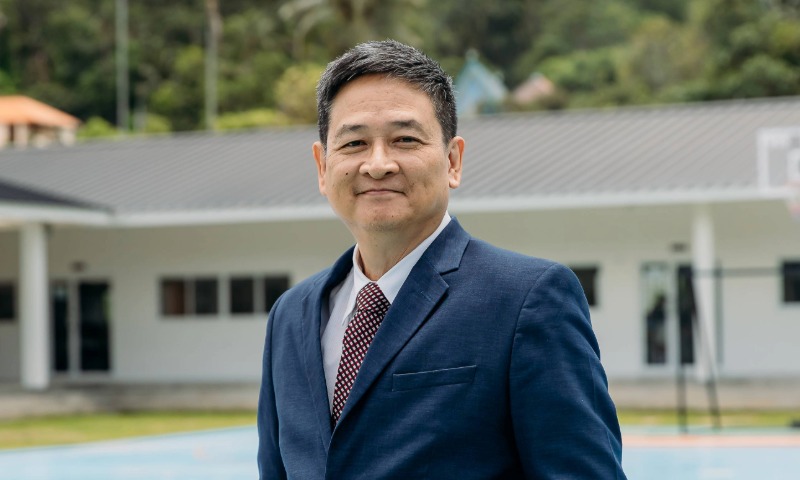
Educational leadership today demands more than academic oversight. It calls for disciplined governance, strategic clarity, and the ability to navigate financial, technological, and global complexity. Joseph Thanin Dhammalongkrot has spent over three decades operating at this intersection.
With leadership and advisory experience across more than ten institutions in Thailand’s private and international school sectors, his career includes senior roles at Saint Dominic School, Don Bosco School, SBS International School Chiang Mai, and Saint John Mary International School, along with quality assurance oversight within the Sarasas Affiliated Schools network. His work has spanned institutional governance, operational restructuring, curriculum modernization, ESL integration, and digital transformation initiatives.
Formed within the Catholic educational tradition, Joseph approaches leadership as enterprise stewardship rather than campus management. He advocates measured modernization, scalable academic systems, and governance alignment that protect institutional identity while ensuring long-term sustainability.
In an exclusive conversation with K12 Digest, Joseph discusses sustainable school leadership in an age defined by financial pressure, global competition, and rapid technological change. He highlights the importance of protecting academic standards while managing growth, leading institutions through complex transitions, and aligning governance with long-term credibility. He also shares his perspective on global benchmarking, portfolio positioning across campuses, and the disciplined integration of AI to strengthen operational efficiency without compromising educational integrity.
You have held senior leadership roles in international education. Looking back, what key experiences or turning points have most shaped your philosophy as an educator and leader?
My leadership philosophy was shaped not by a single defining event, but by repeated moments where institutional sustainability, academic integrity, and financial pressure intersected. One particularly formative experience occurred when I was encouraged to increase admissions despite clear academic readiness gaps. While short-term enrollment growth would have strengthened revenue, it would also have introduced long-term academic and reputational risks.
In that moment, the decision was not merely about student intake; it was about institutional positioning. A school’s brand equity is built on trust, outcomes, and consistency. Compromising standards for immediate financial relief weakens long-term valuation and stakeholder confidence. Choosing disciplined enrollment control reinforced my conviction that sustainable growth must be strategically managed, not opportunistically pursued.
Across multiple institutions—ranging from international campuses to predominantly Thai academic environments—I have consistently evaluated institutional health through four lenses: governance alignment, academic performance, financial sustainability, and brand credibility. That integrated perspective has shaped my leadership approach. For a single campus or a group of schools, resilience depends on protecting standards while designing growth structures that can scale responsibly across a portfolio.
As someone who has led during periods of change, how do you approach transition while maintaining stability and confidence within a school community?
In multi-campus environments, transition is rarely isolated to one variable. Ownership shifts, senior leadership turnover, or market repositioning often occur simultaneously. In such contexts, stability must be engineered, not assumed.
My first priority during transition is institutional mapping. I assess governance clarity, financial exposure, enrollment trends, faculty retention patterns, and stakeholder sentiment across campuses. Only after understanding these dynamics do I introduce structural adjustments. Visibility remains essential, but presence alone is insufficient; leaders must communicate a coherent strategic framework that links operational decisions to long-term direction.
In one transition period, I engaged representatives from culturally diverse parent communities before implementing changes. International school groups operate within varied cultural expectations regarding discipline, communication, and academic rigor. Listening across these segments reduced resistance and strengthened alignment. At the group level, coherence across campuses requires cultural sensitivity combined with consistent standards.
Over time, I have learned that sustainable transition is not about dramatic reform. It is about disciplined governance, transparent communication, and structured continuity planning. When stakeholders understand both the immediate actions and the long-term vision, confidence stabilizes across the organization.
International K–12 education is evolving rapidly. What are the most significant challenges and opportunities facing school leaders today?
The most significant shift facing educational leaders today is the transformation from institution-based competition to global comparative benchmarking. Schools are no longer evaluated solely within their local markets. Parents assess curriculum pathways, digital integration, university placement outcomes, and institutional branding across borders.
For multi-campus groups, this environment demands strategic differentiation. Not every campus should mirror the same positioning. Some may operate as premium academic hubs, others as growth-market campuses, and others as specialized pathway institutions. Portfolio clarity strengthens brand identity and prevents internal cannibalization.
Digital transformation and artificial intelligence represent both operational and competitive variables. Technology adoption is no longer optional, yet indiscriminate implementation creates fragmentation and cost inefficiency. The challenge lies in aligning digital investment with measurable academic impact and operational efficiency. AI integration must support differentiated instruction, data-informed decision-making, and institutional responsiveness, while preserving academic rigor.
The opportunity for forward-looking school groups lies in disciplined modernization. Institutions that integrate technology strategically, maintain governance coherence, and align campus identity with market demand will remain competitive. Those that chase trends without structural clarity risk diluting both resources and reputation.

How do you see AI transforming teaching, learning, and school leadership?
Artificial intelligence represents not simply a pedagogical tool, but a structural shift in how institutions allocate time, human capital, and decision-making processes. Over three decades in digital education, including ICT leadership, system development, and institutional evaluation, I have observed multiple waves of technological disruption. Each wave required governance adaptation.
AI will increasingly automate routine administrative functions, enhance data analytics, and support differentiated instruction. For school groups, this creates an opportunity to improve operational efficiency across campuses, optimize faculty deployment, and strengthen data-informed strategy.
However, technology must remain subordinate to institutional mission. Governance frameworks, usage protocols, and professional development structures are essential to prevent dependency and protect academic integrity. Conceptual thinking and ethical reasoning cannot be outsourced to algorithms. When implemented with disciplined oversight, AI becomes a multiplier of human capacity rather than a substitute for it.
For group leadership, the strategic question is not whether to adopt AI, but how to integrate it responsibly while preserving institutional identity and educational depth.
What achievement are you most proud of?
I am most proud of designing structured academic support frameworks that were replicable across contexts. In several institutions, I observed that struggling students were often viewed as isolated cases rather than systemic indicators. Instead of addressing issues individually, I developed structured literacy and language intervention models that could be implemented consistently.
In Thai primary education, targeted early literacy intervention improved foundational competencies over successive semesters. In international contexts, ESL integration models strengthened language proficiency, reducing academic vulnerability and increasing retention stability. These were not isolated successes; they were system designs capable of adaptation across campuses.
What makes these initiatives meaningful is their scalability. Educational equity requires systems, not sporadic effort. When intervention frameworks are embedded institutionally, they reduce long-term risk, strengthen academic outcomes, and protect institutional credibility.

What core values guide your decision-making?
In complex organizational environments, clarity is more valuable than authority. While I enter strategic discussions with a defined direction, I subject major decisions to structured consultation. Diverse expertise strengthens institutional resilience.
Constructive disagreement has frequently refined my decisions. Governance in a multi-campus environment requires collective intelligence, not unilateral assertion. When professional dialogue is disciplined and transparent, implementation becomes more sustainable.
Authority alone does not produce durable outcomes. Shared accountability, ethical consistency, and strategic coherence ensure that institutional progress outlasts individual leadership cycles.