



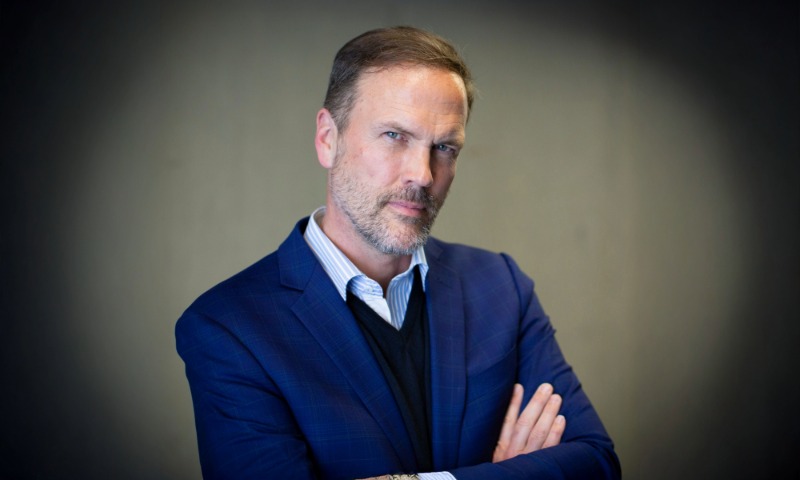
Dr. Conrad Hughes is the Head of School at the International School of Los Angeles. He is Professor in Practice at Durham University, senior fellow at UNESCO’s International Bureau of Education and sits on the Advisory Board of the University of the People. He has published four books on education with Routledge and Brill on prejudice and education, elitism and education, 21st Century competencies and the broadening of assessment. He holds a PhD in English from the University of the Witwatersrand, South Africa and an EdD from Durham University in the UK. He was previously Director General of the International School of Geneva.
Recently, in an exclusive interview with K12 Digest, Conrad shared insights into how six global shifts convinced him that education must be redefined, not just delivered. For the AI era, he insists technology is where thinking starts, not ends: K-12 leaders must be creative, ethical, and critical, ensuring reading, writing, and source analysis are consolidated before AI augments learning, because under-educated students won’t reap AI’s productivity. And if every K-12 leader could obsess over one new metric beyond test scores, it would be critical thinking: the competency under all others that builds intellectual humility, discernment, and informed decision-making, ensuring creativity and collaboration don’t lead down the wrong path. The following excerpts are taken from the interview.
Hi Conrad. Your leadership spans three continents, from India to Switzerland to Los Angeles, with doctorates in both literature and critical thinking. Looking back at that global journey, what was the moment you realized education itself had to be redefined, not just delivered?
The six major global shifts I’ve lived through that have convinced me that profound educational reform could lead to a better world were the end of Apartheid in South Africa (I was lucky enough to vote in the first free and fair elections); the birth of Web 2.0 (I was in the Netherlands at the time); 9/11, which I experienced from India; the release of the iPhone; the 2008 crash and Covid (I was in Switzerland for those three). All of these historical turning points have influenced my research on how education can reduce prejudice, the centrality of critical thinking in an age of technological expansion in the knowledge economy, the importance of viewing schools as places of human exchange, interaction and joy, and how we might design systems that allow multiple gifts to shine.
International schools are navigating AI, polarization, and new accountability demands all at once. Looking ahead, what part of the traditional K-12 model will be unrecognizable by 2030?
I tend to deconstruct these all-or-nothing approaches to the future. First, there will be multiple futures, not just one, depending on where you are; second, there are currently pockets of extraordinary innovation in some areas which could be described as 2030 already and very backward-looking projects in others where it feels more like the 1950s coming back. My guess is that whatever the future of education, it will be paradoxical. When we started looking at alternative transcripts during and just after Covid, it felt pretty ground-breaking, now the idea of tapping into multiple intelligences and different competencies is quite common, and it has been monetised by corporations. So I think that in 2030 we will be closer to a competency-based learning approach in most systems, although at the same time I think that excessive and aggressive testing to divide and sort students based on narrow metrics will exist alongside that: we’ve seen a doubling down on SATs, PISA test scores and statewide and nationwide testing. It will be the development of competency-based learning and the reinforcement of high stakes assessment at once.
However, ultimately, we don’t really know. Covid threw crystal ball gazing out the window: none of those writing about the future of education in 2018 could have guessed that a year later we would be wearing masks or all learning online, or not at all! This is why a great education, which goes beyond the classroom into the school of life, is about making individuals and groups ready for the unknown, and for that you need confidence, fortitude, a centre of meaning in your life, knowledge, skills in domains (even if they become obsolete, you will have a base from which you can transfer) and, perhaps most importantly, the right attitude.
You’ve authored work on critical thinking and now lead a school as AI enters every classroom. What is the single biggest mindset shift K-12 leaders must make to stay relevant in the AI era?
Technology is not where our thinking ends, it’s where it starts. K-12 leaders need to be what their students need to be: creative, ethical, critical. You have to line your ducks up in a row so that the basics are in place before you start accelerating and augmenting your work with AI. The foundations of reading and writing, some sort of critical thinking ability and source analysis need to be consolidated before considering how AI might augment and accelerate knowledge production. Throwing someone who knows very little or nothing into an AI environment will not reap anywhere near the type of productivity and return you will find if that person is well educated to start with.
Wellbeing, safeguarding, and DEI are now core to accreditation. What does “student wellbeing” look like at scale when AI, social media, and geopolitics all enter the classroom daily?
There’s an abundance of negativity thrust onto young people today. They are described as the “anxious generation”, the “lost generation”, suffering from “brain rot” because of screen addiction and doomed to earn less than their parents. This type of thinking has to stop, because it is projecting negativity onto younger generations and in no way reflects the type of optimism and hope we should be generating as educators. Wellbeing is a subtle, fragile entity that comes from feeling loved and accepted in a community, not labelled and pitied.
I believe that a strong educational programme that is holistic in nature, encouraging participation in the arts and sports, community engagement and academics, along with a caring and supportive entourage, is what young people need to thrive. Most especially, we need to believe in them, set them up for success and respect the extraordinary capacities they have for creative thinking and new ways of navigating the world, ways that older generations perhaps do not quite understand. Adults need to lead the way by exposing young people to the beauty of ideas, the power of passion for learning, the courage to stand up to bullies and the wisdom to be grateful for whatever they have, no matter how great or small. Educators should never forget to seek out gifts in young people, for they are there, and to recognise them and let them know, telling them “you can go far, you are special, I believe in you”.
Leaders are shaped by the ideas they return to. Is there one book, from literature or education, that sits on your desk year after year, and what line from it still guides your decisions?
I try to find different reflections on leadership in books not necessarily written for that purpose, because to me leadership is merely an extension of your inner core outwards and should not be garnered in some sort of rigid leadership manual you keep coming back to. I’ve been reading AC Grayling’s History of Philosophy. Grayling is a mentor for me and the leadership lesson in his writing is less what he is describing and more how he describes it: precisely and authentically, without trying to take short cuts or shirk off complexities. The lesson I take from his writing is that when you are a leader, respect the people around you and don’t imagine you need to somehow dumb things down for them, on the contrary, have the humility to know that they might know much more than you and, therefore, express yourself earnestly and not “strategically”.
You operate at the intersection of policy, philosophy, and people. When you need to disconnect and restore your own capacity for critical thinking, what is the one activity that brings you clarity?
I love to walk in the wild, whether it be the desert, by a shoreline, in the bush, a forest, in the mountains or in a valley. We have an ancient genetic connection with the wild and rekindling it heals us, giving us immense energy and clairvoyance. If you’re ever struggling with something in your life, go outside at night, find a quiet space, look at the stars and connect with your inner self, put things into perspective and thank the cosmos for its power and presence. Not long ago I was in a forest of Redwoods near Big Sur in California. Some of those trees are over 1000 years old. Just being in the presence of such an overwhelming primeval force immediately resonates within you, connecting you with something much bigger than yourself.
You empower learners to become agents of positive change. If you could give every K-12 leader one new metric to obsess over in the AI era that isn’t test scores or enrollment, what would it be and why?
Critical thinking because, if you think about it carefully, the one competency that sits under all others is that which pushes you to open your mind to new ideas, seek new information, know how to listen, understand what you can trust and what you cannot trust and, eventually, take a decision that is informed and your own. Critical thinking is much more than judgement, it’s about intellectual humility. I think that being creative, a lifelong learner, a good communicator and a team player are all important, but all of them can lead you down the wrong path without discernment, honesty and deep thought.