




Dr. Kip Glazer is the principal of Mountain View High School in Silicon Valley. She is the author of Ready to Lead with AI: A Practical Guide for School Leaders, a Google Certified Innovator, and a CSTA Equity Fellow. She advises the EngageAI Institute and contributed to the U.S. Department of Education report “Artificial Intelligence and the Future of Teaching and Learning” in 2023. She holds an Ed.D. in Learning Technologies from Pepperdine University. Originally from South Korea, she is most proud of her two sons, both West Point graduates and Army officers.
Recently, in an exclusive interview with K12 Digest, Dr. Kip Glazer shared insights into how a paused district Chromebook rollout revealed her core conviction that tools have little impact if the leader of the building doesn’t believe in them. Her constant belief is that education exists to create an educated populace for the protection of democracy, a moral imperative she pursues by being the school leader she would want for her own children. She also shared her future plans, words of wisdom, and much more. The following excerpts are taken from the interview.
Hi Kip. Every leadership story has a first chapter that feels small at the time. Looking back at your earliest role in education, what moment made you realize you wanted to lead change, not just participate in it?
Imagine getting the news that you will be in charge of the Chromebook rollout for an entire district, only to be told that one of the site principals wants to wait until he is more confident about the timing. His decision paused the plan for that particular school for a full year, while other schools embraced the pilot, and there was nothing I could do.
I was in that very situation when I was doing my favorite job as the District Instructional Technology Coach. I absolutely loved that role because it combined my two passions: teaching and technology. I was the person helping teachers, staff, and students with technology. But I could not move the agenda forward because the principal was not on board. As I write in Ready to Lead with AI, tools, strategies, and plans have little impact if the person in charge of the building doesn’t believe in them.
Growing up, I never thought I would be an educator, let alone a school leader. But sometimes life opens a path that you did not know was open. I am so fortunate to have been an educator, and now a school leader who can support our staff and students.
What do you love the most about your current role?
Our students. I absolutely, positively love working with our students. They are funny, intelligent, and thoughtful. I learn so much from them, and I try to spend as much time with them as I can.
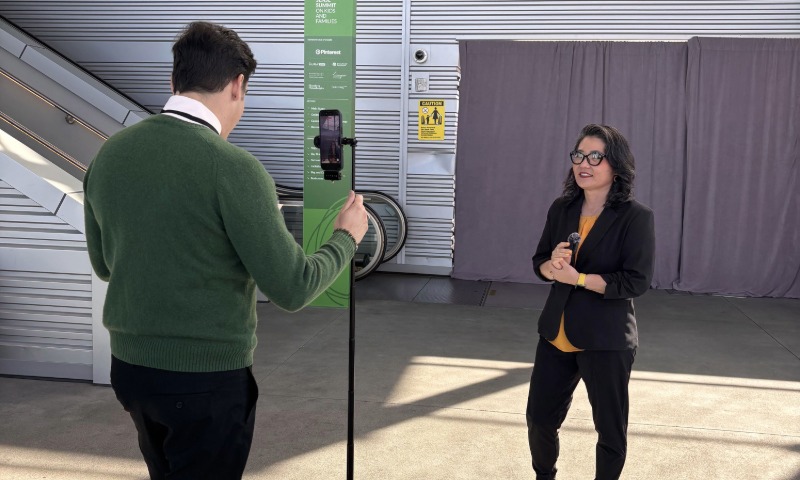
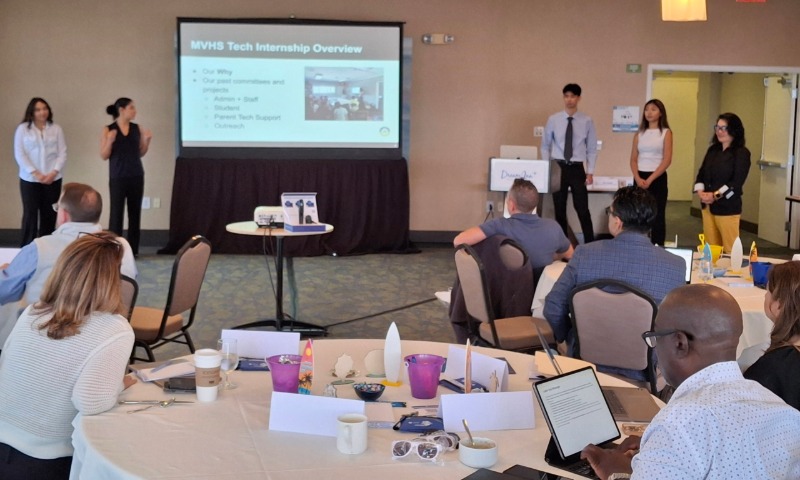
As a principal, it is not easy to maintain regular contact with students, which is why I started two student groups: the Principal’s Advisory Council (PAC) and the Principal’s Technology Internship. I meet with our PAC students once a month to receive feedback from a wide variety of voices. I also meet with the Tech Internship leaders once a week to work on a range of projects. While I appreciate and respect our teachers and staff, I try to spend as much time as possible with our students. After all, we are here for our students.
Generative AI moved from novelty to classroom reality in under two years. Which AI trend in PreK–12 do you think is overhyped, and which one is dangerously underhyped?
Overhyped: the idea that AI systems can replace teachers, and in some versions of this fantasy, replace schools entirely. That conversation is loud right now, and it is built on a misunderstanding of what learning actually is. Even before OpenAI introduced ChatGPT to the world, I had been working with learning scientists on National Science Foundation(NSF) funded projects involving many different AI systems, and one thing the research consistently shows is that learning is more than knowledge acquisition. Learning is fundamentally social. Any belief that AI can allow society to reduce the human workforce in schools is overhyped, and it gets the purpose of school wrong.
Underhyped: the workforce and societal transformation that generative AI is about to drive, and the leadership challenge that comes with it. Treating GenAI as just another technological tool in schools is a serious mistake. GenAI has the potential to hyper-augment and even hyper-automate mundane tasks, which will reshape the employment landscape our students are walking into. As an educator and school leader, I feel compelled to lead the transformation of the traditional education system rather than wait for it to happen to us. Definitions matter here. A large language model is not the whole of artificial intelligence, and conflating the two leads us to make decisions about both the technology and our students’ futures with the wrong mental model. Educators and school leaders must act now rather than waiting for someone else to lead this work, which is exactly why I wrote my book.

Writing Ready to Lead with AI signals deep conviction in this topic. What personal or professional experience convinced you that school leaders needed that book right now?
I became a high school principal in July of 2019. Before I had even finished a full year in the role, I had to close the school due to the pandemic in March of 2020. When I first started the job, I had a long list of people to call for advice. Experienced and wise school leaders were ready, willing, and able to support me. Once the pandemic hit, however, there was no one to call. In fact, I became one of the leaders other people called, because of my background in technology.
The introduction of generative AI felt extremely similar. School leaders do not have many experienced site leaders they can call when they need help with AI. Because I remember how it felt not to know where to start when the pandemic hit, and how much I wished there were someone with a bit more experience on the other end of the line, I decided to share whatever knowledge I had.
Many former and current educators can support classroom teachers with AI, but the practitioner perspective from school leaders working at the intersection of learning science, technology, and AI is still rare. As a Google Certified Innovator, a CSTA Equity Fellow, and a practitioner advisor for EngageAI, I wanted to write an accessible book that gives educators and school leaders a real starting point.
The book includes many stories of successes and struggles as I have figured out how to work with our District, our teaching staff, our non-teaching staff, our students, our parents, and the learning science field. Rather than a book focused on theory, I wanted a practical guide that is easy to read, so that anyone picking it up can gain basic knowledge about AI and the confidence to lead this work as an educator and a school leader. I hope I succeeded.
From your first day in PreK–12 to authoring a book and advising companies, what belief about education has stayed constant for you?
I believe the purpose of education is to create an educated populace for the protection of democracy. Creating an educated populace, in my humble opinion, is a moral imperative that any civilized society should pursue relentlessly. That foundational belief has never changed, and I work hard to be the educator and the school leader I would want for our own children. I also believe in pursuing excellence in everything I do, even if I do not always achieve it.

Every leader has a go-to tool that isn’t software. What physical object on your desk keeps you grounded or creative during long strategy days?
I keep a favorite pen on my desk and a journal nearby. Reflection is the tool that keeps me grounded, and writing is how I do it. I find it important to think carefully about the day I had and the decisions I made, and writing slows me down enough to do that well. I also like to take a walk very early in the morning so I can start the day with a clear mind.
Inspiration often comes from people we’ll never meet. Which historical figure or contemporary thinker do you wish you could invite to a faculty meeting?
Oprah Winfrey. Hands down. I find her fascinating and inspirational, and I deeply respect her ability to communicate with clarity, warmth, and authority. Those are the qualities school leaders need right now, especially when we are talking with our communities about something as new and uncertain as AI. I would want her in the room to remind us that how we say things matters as much as what we say.
If you could put one quote on the wall of every school leadership office, what would it say and whose words are they?
“Do what you can, with what you have, where you are.” Theodore Roosevelt, from his 1913 autobiography.
I have leaned on that line through every hard decision I have made as a principal. There is no perfect moment. There are no perfect resources. There is only the building you lead, the people in it, and the day in front of you. School leaders who internalize that sentence stop waiting for permission and start doing the work.
Where do you see yourself in the next 5 years?
This is a tough one. Because I love being a high school principal, I can see myself doing the same job in five years. But I also want to make a significant impact on the education field. So if there is an opportunity that lets me work with educators and leaders across the country and beyond, continue speaking and writing, and contribute to the field at a larger scale, I would be very open to it. And whatever else changes, I am certain I will write a couple more books. I have three in the works already!
If you could give one charge to every K–12 leader reading this, what would you ask them to commit to this school year regarding AI and human flourishing?
Don’t wait for the perfect moment to learn and innovate. Iterate, learn from what does not work, embrace the uncertainty, and share your struggles and successes now. Loudly. Publicly. So the people in your organization receive permission to follow.