



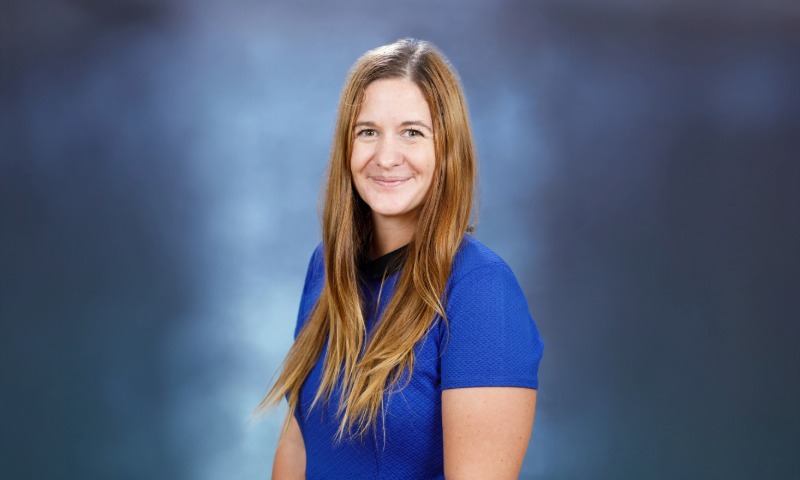
Emma Weston is an innovative educational leader with over 15 years of international experience across London, Taipei, and Bangkok. She holds a degree in Primary Education and Global Citizenship from the University of Chichester and a Master’s in Educational Leadership. Deeply passionate about Early Years and Primary education, she collaborates with experts such as Erin Kent Consulting to strengthen literacy instruction and empower teaching teams. Known as a “marigold” leader who helps others thrive, Emma focuses on instructional coaching, capacity building, and trust. While embracing AI as a supportive co-pilot for teaching, she champions hands-on learning, play, and strong community connections in education.
In an exclusive conversation with K12 Digest, Emma Weston talks about her journey into curriculum innovation and how international teaching experiences shaped her philosophy of learner centered education. She shares insights into balancing academic rigor with student wellbeing through project-based learning and explains how interdisciplinary learning labs connect classroom learning with real-world impact. Emma also reflects on the evolving challenges in K12 education, particularly the need to develop future-ready skills in an age of rapid technological change.
You have been deeply involved in learning design at VERSO. What initially drew you toward curriculum innovation, and what milestones in your journey have most shaped your educational philosophy?
My path toward curriculum innovation actually began at the very start of my career during my degree at the University of Chichester. It is one of the few universities to offer a specialization in Primary Education combined with Global Citizenship. That dual focus fundamentally shaped my belief that education cannot just be about passing standardized tests; it must be about developing thoughtful, active citizens.
A major milestone was transitioning from the UK system (after 4 years in London) to international environments in Taipei and then Bangkok. Adapting to diverse, multicultural classrooms highlighted the limitations of a rigid, “one-size-fits-all” curriculum. When I became a Campus Principal at Garden International School, and later a Cohort Leader at VERSO, I realized that true curriculum innovation—like Design Thinking—allows us to build the curriculum around the learner. My Master’s research focus on Student Agency further solidified my philosophy: when students have ownership and relevance in their learning, the depth of their understanding increases exponentially.
As a Cohort Leader, how do you balance academic rigor with student well-being and agency in a project-based environment?
I firmly believe that academic rigor and student well-being are not mutually exclusive; in fact, true agency promotes well-being. The key to balancing them in a project-based environment lies in the architecture of the curriculum. I rely heavily on the Understanding by Design (UbD) framework. By starting with the end in mind—identifying the rigorous, standards-based learning goals we need to hit—we create a secure academic framework.
Once that rigorous framework is in place, Design Thinking provides the vehicle for delivery. It allows students the agency to choose how they engage with those concepts. For example, a student might struggle with traditional literacy assessments but thrive when asked to prototype a solution and pitch it verbally. Because we differentiate by design, students feel seen and supported, which drastically reduces anxiety and boosts their well-being, all while meeting high academic standards.
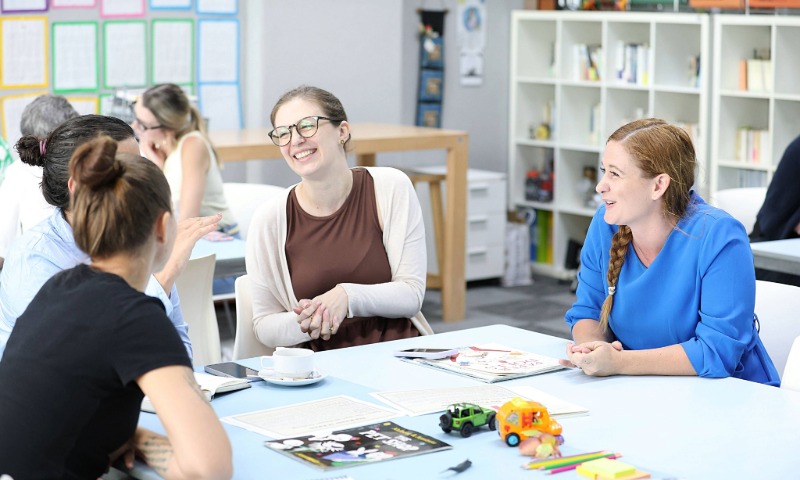
VERSO is known for its interdisciplinary Learning Labs (LeLABs). What have been some of the most meaningful or transformative learning experiences you have helped design?
Some of the most transformative LeLABs I’ve helped design are those that bridge the gap between the classroom and the real world. In my role as Trip Leader for Early Years and C1-4 (Lower Primary), I ensure we facilitate at least one off-campus learning experience every half term.
One of the most meaningful aspects of these LeLABs is how we link them directly to charity, service, and our school philosophy. For instance, designing a LeLAB where young learners investigate local community needs and then actually go out into Bangkok to partner with a local organization. When students see that their design-thinking prototypes or fundraising efforts have a tangible impact on real people, it transforms the learning experience. It takes the abstract concept of “Global Citizenship” that I studied at university and turns it into a lived, early-childhood reality.
School education is evolving rapidly. From your perspective, what are the biggest challenges and opportunities facing K–12 education today?
The biggest challenge facing K-12 education today is that our traditional models of schooling are struggling to keep pace with the realities of the future. The world is evolving rapidly, particularly with the exponential development of AI, and education is often left playing catch-up.
We need to be aggressively teaching and developing “future-ready” skills—like complex problem solving, adaptability, empathy, and technological fluency. However, a major hurdle is that our formal schooling and standardized assessments are not designed to measure these skills. We are still largely assessing rote memorization in an era where information is instantly accessible.
The opportunity here is for schools to rethink their purpose. We need to invest heavily in our teachers, giving them the time, training, and professional development required to shift their pedagogy. By embracing models like design thinking and inquiry, we have the opportunity to transform schools from places of compliance into incubators of innovation, ensuring our students are not just prepared for tests, but prepared for life.
How are AI and other emerging technologies influencing your work as a Learning Designer? Where do you see the greatest potential, and where do you exercise caution?
As a Learning Designer, I view AI as a powerful co-pilot. The greatest potential lies in its ability to support differentiation and teacher capacity. AI can help us instantly adapt reading levels for EAL students, generate tailored scaffolding for neurodiverse learners, or brainstorm diverse entry points for a new inquiry unit. Furthermore, AI can serve as a powerful tool for generating rapid, personalized formative feedback on student work. By streamlining these processes, AI actually enhances human interaction; it buys teachers time—time that can be redirected away from administrative tasks and grading, and back into facilitating targeted, one-on-one coaching conversations and building deeper relationships with students.
My caution, particularly in Early Years and Lower Primary, is ensuring that technology never replaces the fundamental human elements of learning. Education is inherently relational. I am cautious of tech being used as a passive pacifier rather than an active tool for creation. We must ensure that hands-on play, sensory experiences, and face-to-face peer collaboration remain the non-negotiable core of early learning.
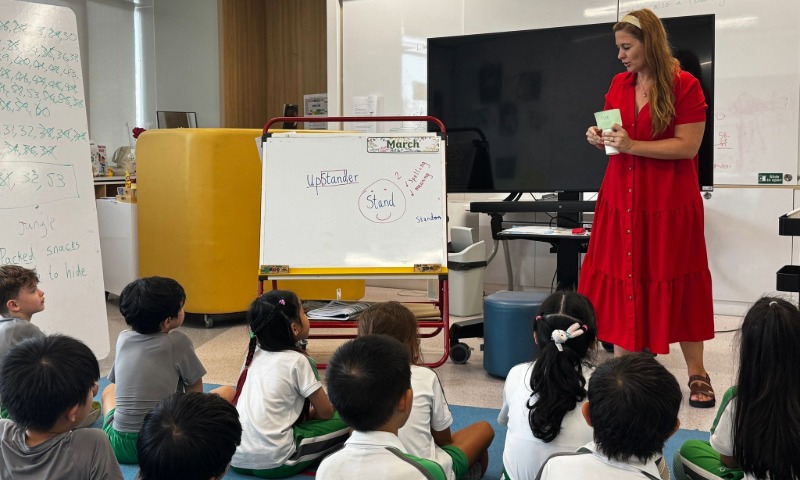
Leadership in innovative schools often requires navigating ambiguity and change. How would you describe your leadership style, and what principles guide your decisions?
A former line manager once described me as a “marigold”—someone who makes those around her shine brighter. I hold onto that deeply. My leadership style is highly relational, empathetic, and focused on capacity-building.
Navigating ambiguity requires trust. In an innovative environment like VERSO, where we iterate and prototype constantly, staff need to feel psychologically safe to take risks and sometimes fail. My guiding principle is always: Does this serve the whole child? When we are faced with difficult, ambiguous decisions, anchoring back to our core values—well-being, inclusion, and student agency—clears the fog. I lead by getting into the trenches with my team, modeling instructional practices, and coaching them through challenges so they feel empowered.
Outside of your professional role, what personal interests or values help you stay grounded and inspired? What advice would you offer to young educators or students aspiring to make a difference in education?
Living internationally—from London to Taipei to Bangkok—has instilled in me a deep love for cultural immersion and travel, which keeps my perspective broad and fuels my passion for global citizenship. I stay grounded by staying connected to the local communities I live in.
My advice to young educators is two-fold. First: be a marigold. Find the positive, collaborative people in your school and grow alongside them; education is a team sport. Second: never lose sight of the student’s perspective. It is easy to get caught up in curriculum documents, data, and administration. But if you constantly ask yourself, “What does it actually feel like to be a child in my classroom?” you will intuitively design learning experiences that are engaging, inclusive, and deeply meaningful.