



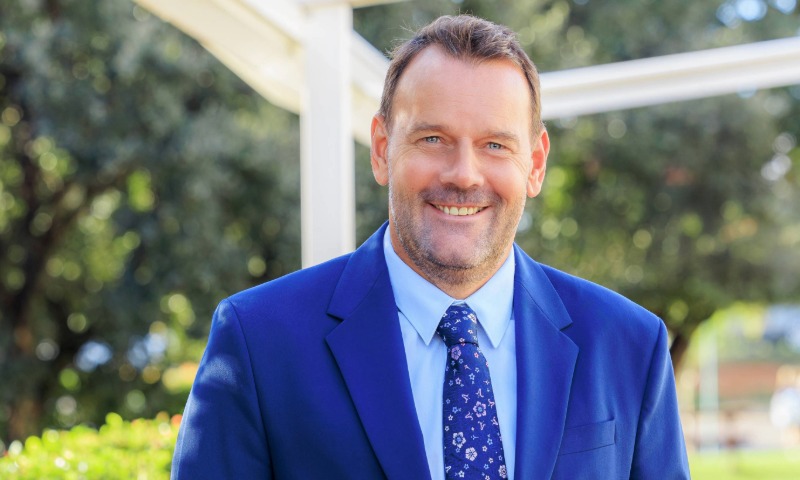
David Jenkins is an experienced international school leader with nearly 30 years in education across Europe, Africa, Asia, and the Americas. He has led IB continuum schools through authorisations, evaluations, and periods of growth, and is known for being a visible, people-centred leader who values strong relationships with students, staff, and families. Passionate about holistic education, David believes academic excellence and wellbeing go hand in hand. Outside school, he enjoys sport and travel and leads with a simple principle: take the work seriously, but not yourself.
Recently, in an exclusive interview with K12 Digest, David shared his journey into education leadership, insights into how schools can better support student mental health and wellbeing, his favorite book, future plans, words of wisdom, and much more. The following excerpts are taken from the interview.
What inspired you to pursue a career in education leadership?
I started teaching because I enjoy working with young people. I moved into leadership at a very early age, primarily due to luck (depends how you look at it!). I had just started my teaching career at the age of 22 and the school I was working in had just started the process to become an IB Middle Years Programme school. It was new to everyone, and no one wanted to take the lead on the coordinator’s role. Fresh out of university and belief in myself (with a sprinkling of naivety on top!), I went for it. I soon realised that the right leadership can make everyone’s life better: students, teachers, and parents alike. Early on, I saw how a good decision at leadership level could turn a stressful school into a positive one, and a poor decision could do the opposite. That was enough motivation for me to want to help tip the balance in the right direction and I haven’t looked back since.
What do you love the most about your current role?
100% the students. The best part is still being in the thick of school life. I enjoy talking with students, supporting teachers, and working with parents; and yes, that includes early mornings, late evenings, and the occasional difficult conversation. I also enjoy the strategic side of the role, but only when it stays connected to reality. I’ve learned that the best strategies are the ones that still make sense at 8:15 on a wet Monday morning.
Do you think AI in classrooms by 2030 will be an opportunity or threat?
Having led IB schools through authorisations, evaluations, new programmes, and technological change, I’ve learned that change works best when people understand why it’s happening. I have seen the value of AI and how it can help, not hinder, education (for students and teachers). I’m optimistic about technology and AI, as long as they support teachers rather than replace them. No algorithm has yet managed playground duty or a worried parent at pick-up time, and I suspect it won’t anytime soon.
How do you think schools can better support student mental health and wellbeing?
This is becoming an increasing concern of mine, and I am finding youngsters are facing challenges that I never had as a student. I don’t believe wellbeing can be fixed with a single initiative or a poster in the corridor. It comes from adults who notice students, routines that feel safe, and expectations that are high but human. When students feel known and supported, behaviour improves, learning improves, and everyone sleeps better; including the Head.
In your opinion, should “international-mindedness” be part of national curricula?
In today’s day and age, it has to; this is non-negotiable, and to avoid it is reckless. After working across Europe, Africa, Asia, and the Americas, I’ve led schools where students speak two or three languages before lunchtime. That experience teaches you quickly that there’s more than one right way to do things. International-mindedness, for me, is about curiosity, humility, and a sense of humour when cultural assumptions don’t quite land as expected. We need to embrace and celebrate our differences, and focusing on cultural awareness is a key aspect in achieving this.
Is there a book that shaped your view on education? Why?
Being a true IB Learner, I will choose to be a risk-taker here. I grew up with the likes of Not The Nine O’clock News, The Young Ones, Only Fools & Horses, and the iconic Blackadder. These shows, in their own way, questioned formal education, and they showcased the importance of common sense, soft skills, and the need to not take things so seriously. One book that’s stayed with me is Stark by Ben Elton. It’s sharp, funny, and uncomfortably relevant, especially in how it highlights inequality, privilege, and short-term thinking. It reminded me that education isn’t just about qualifications; it’s about helping young people think critically, question power, and understand their responsibility to the world around them. Also, any book that makes you laugh and feel uneasy at the same time is probably worth paying attention to.
Do you have a personal mantra you live by? What is it?
As a parent and as an educator I often refer to the importance of those skills that require zero talent. Being respectful, making an effort, collaborating, being on time and caring are all things that require zero talent, yet they are some of the most important traits in life; more so than being able to regurgitate information in an exam setting, or a grade.
What’s one thing you’re passionate about outside of education?
Sport; playing and watching. While I used to be very competitive when I was younger, I always enjoyed the banter and the camaraderie of being part of a team. I was fortunate enough to captain several teams I played for in my younger years, and I always relished the opportunity and the responsibility that came with this. Sport has also been my crutch throughout my nomadic existence. Before I was 18, I had lived in Denmark, Iran, Portugal and three different regions in the UK. Football was my “in” and how I made friends. My adult life has taken me back to Denmark, to Spain, the US, Mauritius and Portugal, and the strong bonds I still have in each area are because of sport. This is also why I am a very strong supporter of the promotion of sports in schools.
Where do you see yourself in the next 5 years?
In July 2026, I will be taking on a new challenge in Oman, and I am very excited by the prospect. Having worked in different parts of the world, the Middle East is one of the few regions I have yet to experience. I see myself continuing to lead by example and empowering my colleagues while remaining focused on people, culture, and student experience. Most importantly, I see myself still learning; always learning. Anyone who says they’ve got leadership completely figured out probably hasn’t been in a school recently.
Looking back on your career, what advice would you give to someone just starting out in school leadership?
The key aspect for me is visibility. You should be the first person the students and parents see when they come in through the gates and as visible and available throughout the day. Stay connected to teachers, students and parents. Listen more than you speak, and remember that leadership is a marathon, not a sprint. It is also imperative that you do not take yourself too seriously and you also own every decision; the good, the bad and the ugly ones. And trust me, there will be bad ones. Also, never underestimate the power of a well-timed cup of coffee and a genuine “thank you.”