



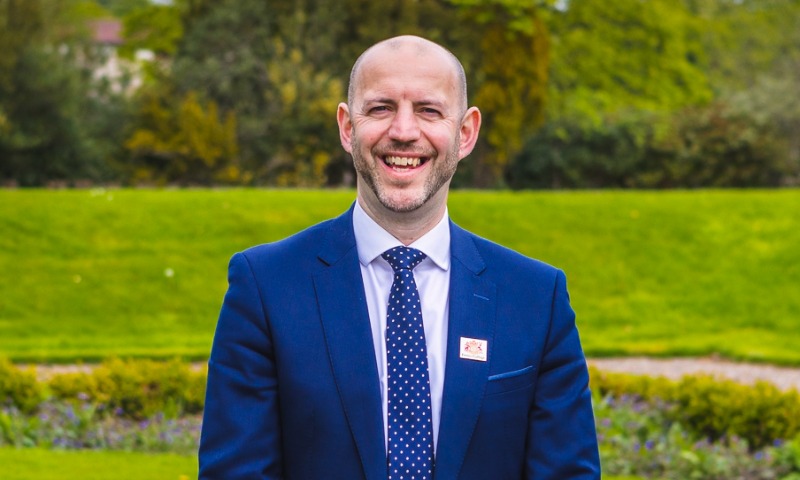
With nearly two decades of experience in British and international education, Jonathan Marchant has held senior academic leadership roles at several of the UK’s most respected schools. Formerly Deputy Head (Academic) at Fettes College and Head of Sixth Form at Cheltenham Ladies’ College, he has led IGCSE, A Level, and IB Diploma programmes and helped students gain places at top global universities. Jonathan has also worked internationally, including in Japan and The Bahamas, and writes regularly on education, most recently for The Times on AI in schools.
Recently, in an exclusive interview with K12 Digest, Jonathan shared his professional trajectory, insights into the most pressing issue facing education today and how it can be addressed. He also shared his favorite quote, personal hobbies and interests, future plans, pearls of wisdom, and much more. The following excerpts are taken from the interview.
Hi Jonathan. Can you tell us about your career path and what led you to become a teacher and eventually a school leader?
My route into teaching—and later into school leadership—was not the typical journey for someone who has spent more than a decade working in prestigious independent schools. I grew up attending my local state school, where I particularly excelled in History, and became the first in my family to go to university. After graduating, my then-girlfriend (now wife) was determined to move to Japan to teach English. She was a keeper—we’ve now been together 25 years—so I followed her.
Living and working in Japan was transformative. Experiencing a culture so different from our own helped us realise how much we enjoyed working with young people and set us firmly on the path toward teaching.
On returning to the UK, I completed my teacher training in Secondary History at the University of Bath, which I loved. I was fortunate to be given my first teaching post at Farmor’s School in Gloucestershire by Jim Speake, who took a chance on me. From day one I taught exam groups, including A Level students, which I relished. Drawing on my Master’s degree in History allowed me to enrich my classes and bring academic depth to my teaching.
I was soon promoted to Assistant Head of Sixth Form, supporting students with university applications—a part of the role I found particularly rewarding. Later, I became Head of History at Marling School, a selective grammar school, where I spent four years designing curriculum, leading a team, and overseeing competitive university applications. During this time, we saw remarkable success, including a rise in Oxbridge offers from one per year to nine in my final year.
These experiences gave me the confidence to apply for the Head of Sixth Form role at Cheltenham Ladies’ College, which remains one of the best professional decisions I have made. CLC introduced me to the International Baccalaureate and to working with students from all over the world, sparking my interest in international education.
After 15 years of working within a 20-mile radius—across state, grammar, and independent sectors—my career took on a more global trajectory. I became Deputy Head (Academic) at Fettes College in 2021, working under Helen Harrison and helping introduce innovative programmes such as Engineering, Enterprise and Technology, while restructuring academic leadership. I was then headhunted to set up King’s College Bahamas Secondary School and subsequently appointed Founding Head of Senior School at Epsom College Malaysia.
From 2021 to 2025, my family and I have travelled thousands of miles, embraced new cultures, and grown through each experience. We have loved every moment.
What do you love most about your current role?
Working in international education is endlessly inspiring. You learn so much from students whose cultural backgrounds and perspectives are wonderfully diverse. I’ve also been deeply impressed by our EAL department, whose flexibility ensures students experience the right level of challenge while developing their English. Their ability to adapt to the wide range of learners they teach is exceptional, and the breadth of courses available allows students to thrive in ways that suit their individual strengths.
What do you think is the most pressing issue facing education today, and how can it be addressed?
The most pressing issue is the ethical and responsible use of AI. I’ve written about this for The Times. AI is reshaping learning, and we cannot ignore it nor simply ban it. Instead, we must teach students how to use it responsibly.
One of the best approaches is helping students understand prompt engineering. This encourages them to move beyond using AI to generate plagiarised work and instead use it as a tool for deeper inquiry, reflection, and support. When students learn to ask better questions, AI becomes an aid to learning rather than a shortcut.
What role should technology play in the classroom? How can it enhance learning?
Technology should be purposeful—not used for its own sake. The modern professional world is built on a combination of digital inking and typing, and we would be doing students a disservice if we didn’t equip them to work in this way. Well-used technology enhances efficiency, creativity, and organisation.
AI, in particular, is incredibly powerful when given accurate, well-selected information. It is excellent at identifying common errors and offering suggestions. Like any system, the quality of its output depends on the quality of its input. Teaching students how to feed AI good information will make them stronger learners and, one day, stronger professionals.
What qualities and skills are essential for successful teachers, and how do you develop these in your staff?
Building rapport by meeting students at their level is fundamentally important. Without strong relationships, even the most expert subject knowledge may fail to connect. Teaching is, at its heart, an act of communication. The ability to adapt one’s communication style to suit the learners in front of you is—quite simply—gold dust.
In developing staff, I place emphasis on reflective practice, open dialogue, and encouraging teachers to understand not just what they teach, but who they teach.
What is your favourite quote?
“All that is required for the triumph of evil is for good people to do nothing.”
—Edmund Burke
Have you had any mentors or role models who influenced your career?
Eve Jardine-Young, who appointed me at Cheltenham Ladies’ College, has been enormously influential. She is an intellectual powerhouse, yet her emotional intelligence is what makes her leadership exceptional. From Eve, I learned that leadership isn’t about “command and control”—it’s about empathy, nuance, and reading the people around you.
What hobby or interest helps you recharge outside of work?
I love running, football, golf, History, and keeping up with current affairs and politics. Most importantly, I treasure time with my family. I’m currently working away from them, so this last one matters more than ever.
Where do you see yourself in five years?
I hope to be happily leading a school—or perhaps a group of schools—continuing to shape meaningful educational experiences for young people.
What advice would you give teachers aspiring to leadership roles?
If you enjoy variety and want to make a genuine difference to the world our children will inherit, school leadership is an extraordinary path. Few roles offer the ability to influence young lives so meaningfully. Invest your time in teaching the world’s children—there is little that is more rewarding.