


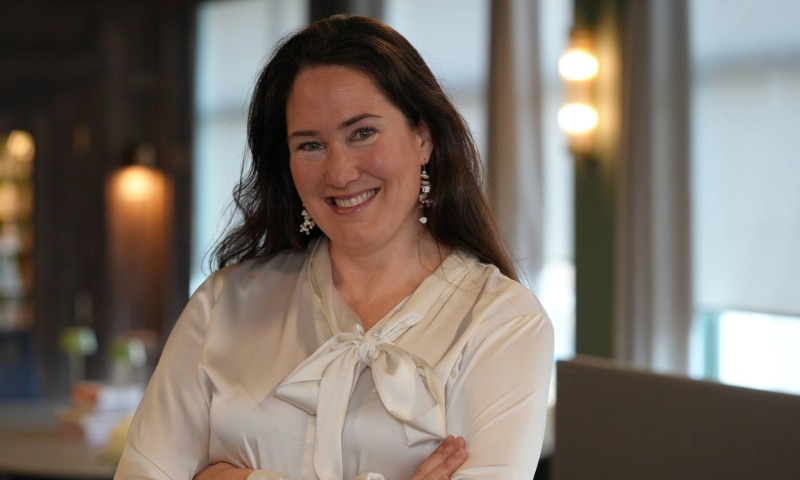
Heather Rhodes is the founder and Principal of Highgrove Education, an online British secondary school for academically ambitious pupils who want to achieve their potential outside the traditional school environment. She has been a pioneer in online education for over ten years, previously running Harrow School Online, the world’s most academically successful online sixth form. She is also a trustee at Svitlo Education, an online extra-curricular school for Ukrainian students impacted by the war. Heather is particularly interested in the potential of online education for building global communities of learning and increasing the accessibility of exceptional education.
Recently, in an exclusive interview with K12 Digest, Heather shared insights into her decade-long journey pioneering online education, revealing that digital learning not only matches but often outperforms in-person teaching because it offers an “insider view” of student thinking through real-time data, shared whiteboards, and closer face-to-face interaction on screen. As founding Principal of Harrow School Online, she challenged elite education’s reliance on supervision by embracing flipped learning, where 60% of study time was independent and students carried responsibility for their education, a model that produced A-level results surpassing Harrow School itself and proved that removing oversight and “giving students the chance to fail” drives stronger outcomes. She also shared her personal hobbies and interests, future plans, words of wisdom, and much more. The following excerpts are taken from the interview.
Hi Heather. Pioneering online education for over a decade means you’ve seen skepticism turn into momentum. Thinking back to your earliest work in online tutoring for international students, what moment convinced you that digital could deliver not just access, but excellence?
To be quite honest, when I started out I was surprised to discover that digital learning could outperform in-person teaching. I first set up an online tutorial school through Harrow School Enterprises in 2014, and at the time I was also working for Harrow School as head of English as an additional language. I took on much of the initial online tutoring myself, and because I was also teaching English for Harrow School, I was constantly switching between delivering lessons in person and online. Prior to launching the online provision, I had the idea that distance would be likely to dilute the learning a little, but that something was better than nothing. What I found was the complete opposite.
I found online lessons to be more intense and cover more ground in a shorter time, and my online students consistently made more progress than those I taught in person. Even more surprisingly, I found I got to know my online students faster. Teaching online gives you a wealth of data from a student’s self-study work and real time insights into how they think as they compose written work on a shared whiteboard directly in front of you. Added to that, you spend a lot of time looking into your students’ faces. When I was giving online lessons, it felt like I had an insider view of the learning, rather than looking on from the outside. That’s what did it for me – the realisation that distance learning could actually give you a closer insight into your students.
Becoming the founding Principal of Harrow School Online was a historic first for British independent schools. What was the hardest assumption about “elite education” you had to challenge to make it work online?
Our remit at Harrow School Online was to replicate an elite independent school education, but with an alternative mode of delivery. There was, however, one really significant change. Education at top UK schools generally involves high levels of supervision. At Harrow School, even your homework time is supervised. For us to make learning work online, we had to rely on students working independently.
Before I ever got involved with online schooling, I was a huge fan of flipped learning. That’s an approach which involves students learning materials independently prior to attending a lesson with their teacher, then using class time to consolidate and apply their knowledge with their teacher on hand to support and give feedback. It flips the traditional approach of teachers presenting content in class then students practising it for homework.
At Harrow School Online, we went all in with this approach. Around 60% of study time was independent, with students working through interactive self-study materials prior to attending their lessons. We only had a couple of live lessons per subject per week, then ensured teachers had time for additional one-to-one support if needed. We taught students study skills and gave them weekly individual coaching to help them adjust to this approach, but ultimately, the responsibility for their education sat squarely on their shoulders.
It’s a very different pedagogical approach to traditional schooling, but I was quietly confident it would work. All the same, I was as shocked as everyone else when our first set of A level results came out and we had outperformed Harrow School. It was the same year after year, and we’re now looking at similarly strong academic results from flipped learning with my new school, Highgrove Education. My takeaway from this is that some assumptions are worth challenging. We got better results than one of the most famous schools in the world by taking away the supervision and giving students the chance to fail.
We achieved success by taking away the supervision and giving students the chance to fail.
Online schooling moved from niche to normal after 2020. Which trend in online K–12 do you believe is here to stay, and which one was pandemic hype?
There’s been a lot of unsubstantiated hype around the power of edtech to transform learning. A prime example is virtual reality. Building schools in the virtual world might look great visually in marketing materials, but it adds an unnecessary and slightly clunky layer between teachers and students, and I can only see a very limited number of useful applications for it. Demonstrating science experiments, sure. Spending each day cloaked in an avatar, not particularly convincing. Until you see clear evidence that something produces better outcomes, it’s sensible to be dubious about the hype.
Flipped learning, however, is a trend which I think is here to stay – and one which has power to transform education beyond online schooling. As well as being incredibly powerful for academic progress, it helps pupils develop as strong independent learners, and puts them in the driver’s seat for their education. There’s no reason this approach has to be confined to online schools. Highgrove Education showcases just how powerful flipped learning is when it’s done well. My hope is that will inspire others leading more conventional schools to give pupils more agency in their education.
Accessibility drives your work. What’s one barrier to exceptional education that you’re most determined to remove in the next three years?
One of the most exciting programmes we’re working on at the moment is a partnership with a school in the Himalayas Valley in India, where Highgrove Education will be providing the full academic programme and our local partner will be providing onsite care and support. This is a relatively remote, rural area, where students will be learning from a team of outstanding teachers. We’re setting out to prove that location is no longer a barrier to quality of provision – that wherever you live in the world, you can access a first-class education. We see this as a gamechanger for international education, where one of the key challenges has long been teacher recruitment. Hybrid partnerships make that a thing of the past, offering the best of flipped learning, but with onsite socialising and support.
Many educators want to move into online leadership. What’s the first skill they should build if they’ve only taught in physical classrooms?
Build up your online teaching practice first. Online teaching needs a different pedagogical approach and delivery, and unless you’ve developed your own expertise, you’ll struggle to effectively lead others. If you’re eying up an online leadership position in the long term, you might therefore need to take a step back into a teaching role in the short term to build up your own practice. Choose a reputable school with a strong induction and training programme, and take a look at the profile of other teachers at the school to consider who your colleagues will be and how much you’ll learn from them. Peer observation is a great way of accelerating through the learning curve.
Books often shape how we design learning experiences. What book lives on your desk and influences how you think about community, pedagogy, or technology?
One of the books I’ve been most influenced by is Thinking, Fast and Slow, by Daniel Kahneman. While it’s not a direct dive into pedagogy, it breaks down the processes of thought and decision-making, which are of course fundamental to learning and education. Understanding how prone we are to making short cuts with our thinking is one reason I’m so keen on explicitly teaching metacognitive skills. The more we develop our self-reflection and self-control, the better learners – and thinkers – we become. For me, that’s at the heart of education.
Rest fuels resilience for founders. What hobby, ritual, or weekend activity helps you return to Monday ready to build?
Exercise is non-negotiable for me. It’s my magic trick for getting rid of stress and decluttering my mind. Most weekends follow the same pattern: a 6km run through the woods on Saturday morning, then a 3km swim on Sunday. I’m a far stronger swimmer than runner, so I get overtaken regularly on my run, then comfortably lap most people in the pool. I’m always exhausted by the time I finish my swim, so I sit and stretch for a bit in the sauna until I’m up to walking home. I swim at Highgrove Pool and walk back through Highgrove woods – and yes, Highgrove Education was named after the pool.
If you could put one sentence on the login screen of every online school, what would it say and why?
“It’s good to see you!”
Students choose online school for all sorts of reasons; sometimes after a difficult experience elsewhere, sometimes simply because they want more from their education than their local school can offer. When they log on, regardless of what pushed them towards online schooling, they’re choosing to show up. We’re in direct competition with Netflix for our students’ attention. When they show up all the same, wanting to learn, the least we can do is make them feel welcome.
Legacy matters to builders. Ten years from now, what do you hope a Highgrove graduate says about how online school shaped their life?
I decided to take a fairly significant personal risk in launching Highgrove Education because I see our school as lifechanging. We take in teenagers from across the world who have struggled to find an education that meets their needs, and we deliver them on to top universities. When they get there, our alumni tell us they feel streets ahead of their peers because they’ve already learnt how to manage their time and stay on top of their workload. That journey from struggling with finding the right educational fit to thriving at life is transformational. I’m looking forward to finding out from our graduates ten years down the line what they’ve gone on to do. The best legacy would be hearing that Highgrove set them up to be catalysts for change.
For an aspiring edtech founder who cares about pedagogy, what three mistakes should they avoid that you learned the hard way?
Firstly, the illusion that having institutional backing gives you security. Edtech founders often look for corporate investment. I learnt the hard way that when Pearson owned Harrow School Online, I had no control over the future of the school or its closure. Having seen the risks, when I started up Highgrove, I did it the hard way, without institutional backing. It’s been worth all the long hours and the financial risk I took on personally to have a thriving school where I have control of future direction.
Secondly, the presumption that most people outside the world of edtech understand what you’re talking about. If your whole working life revolves around online education, it’s easy to forget that some people don’t know online schools exist. It might be tempting to talk about synchronous vs asynchronous provision, or the value-added scores you’ve achieved with flipped learning, but only a handful of people will care. It’s important to step out of the bubble and articulate clearly what you offer and who will benefit. Ultimately, parents want to know how you can help their child.
Thirdly, the idea that because you have an excellent solution for a problem, it will be the right solution for every child. We once had a child enrol with us who we later found out had a gaming addiction. With the best will in the world, an online school is not the right solution for a child addicted to gaming. It’s important to be able to identify and articulate who you can help, and equally to recognise who isn’t a good fit for your provision. For us at Highgrove, that means making clear we offer online schooling for pupils who are academically ambitious and are keen to take on agency in their education.