


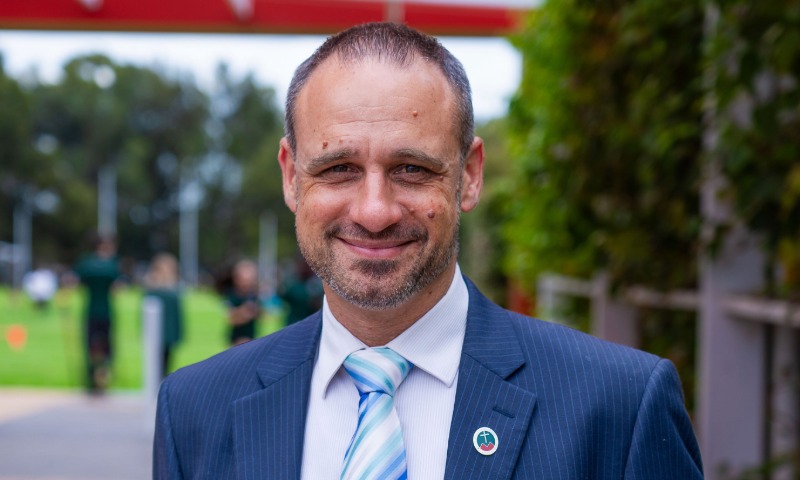
Corey Tavella has been the Principal of Thomas More College, in South Australia, for almost eight years. Over this time, the school has experienced over almost 65% enrolment growth, a 50% increase in Year 12 A Grades, as well as increases in ‘Exceeding’ areas of our National Literacy and Numeracy Asssessments (NAPLAN). He leads a culturally diverse school of 62 different cultures where 56% of students come from an EALD background. This Year the College was selected as one of the 33 Best Schools in Australia by the Educator as a ‘Five Star Best School’. Corey serves on several academic and System leadership committees, and this year was recognised as one of the Most Influential Educators in Australia (the Educator), and last year was an Excellence Awardee for the Australian Principal of the Year (Australian Education Awards). Corey is married and has four children.
Recently, in an exclusive interview with K12 Digest, Corey shared insights into how his journey began with a shift from journalism to education, driven by a passion for developing young people, and how as Principal of Thomas More College he has led significant enrolment growth and academic improvement in a culturally diverse community of 62 cultures. On trends and AI, he noted that K-12 is moving beyond narrow academic success to holistic learner capabilities through initiatives like the TMC Learner Profile, and that AI will make the human parts of teaching more important, helping schools become more human through his vision of Educational Intelligence that balances data-informed action with compassion and professional judgment. The following excerpts are taken from the interview.
What early experience first drew you towards education and leadership, and how did it influence your path?
My decision to be a teacher was surprisingly unassuming; I had initially studied journalism for a year as I enjoyed creative elements like writing and character development. While studying, I was also a part-time supermarket manager and enjoyed working with young people and helping them learn. I was enjoying my studies in journalism, but I realised that I enjoyed the development of young people more and so teaching seemed like a fairly natural transition, especially with a subject like English.
When I then think about my early education career more, I think it was the experience of being in classrooms and recognising that a teacher can completely change how a young person sees themselves. I quickly realised that the content was only part of the work. The real challenge, and the real privilege, was helping students find confidence, purpose and a sense that they were capable of more than they might first have believed; to be their best, and perhaps beyond their best.
My move into leadership grew from that same idea. I wanted to influence not just what happened in my own classroom, but the conditions around every classroom: the culture, expectations, relationships, systems and opportunities that make good learning possible, and also which develop great people. That has remained fairly constant throughout my career. Leadership, for me, is not about being removed from teaching and learning. It is about creating a school where staff can do their best work, and more students can experience success. I often talk to staff of my Leadership according to Tavella belief that the type of teacher you are, is the type of leader you become. For me, that’s become about leading staff, students and teaching and learning environments to be the best they can be.
How do you personally define your role as Principal in your #TeamTMC community?
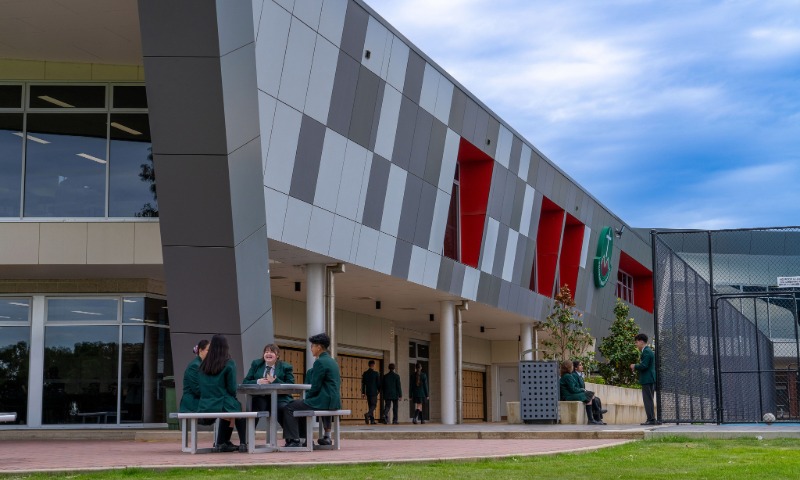
I see my role as Principal as setting the conditions for people to thrive. That means being clear about who we are, what we value and where we are heading, while also creating enough trust for staff and students to take ownership of the work. At Thomas More College, I am not simply the person responsible for running the school. I am a custodian of its culture, its Catholic identity and its future, and I have a responsibility to leave each of those stronger than I found them.
That also means staying close to the life of the College. I need to have a finger on the pulse, understand what students and staff are experiencing and know when to step in, when to challenge and when to let others lead. I often talk about being aware, and then knowing when to dip in and also knowing when to dip out. It’s never really linear. Over time, I have become more conscious that leading a Catholic school is not just one part of the Principal’s role. It is the lens through which every part of the role should be approached, including learning, wellbeing, staffing, growth, resources and relationships.
What are the most significant shifts redefining K-12 education right now?
One of the biggest shifts is that schools are moving beyond a narrow definition of success. Academic achievement remains important, but it cannot be the only measure. Students also need to understand how they learn, what they can contribute and how they will navigate a future that is less predictable than it once was. That is one reason we developed the TMC Learner Profile. It gives students a language for capabilities, self-reflection, agency and growth, rather than defining them only through grades or a final ATAR (Australian Tertiary Admissions Rank). The Learner Profile is now embedded across Years 7 to 12 and has also contributed to work with the SACE (South Australin Certificate of Education) Board on broader assessment reform. For us at TeamTMC, it’s ultimately become a pathway to excellence, and towards (and beyond) personal best.
The other major shift is the expectation that schools will respond more deliberately to evidence. We now have access to more information about learning, wellbeing, attendance, engagement and pathways than ever before. The challenge is not collecting more data. It is turning that information into useful action without losing sight of the individual student. At TMC, our work has evolved from an early Quality Performance Team model into an embedded Data Management Team and data-informed teaching approach. The principle is fairly simple: know earlier, act sooner and improve student outcomes more deliberately.
How do you see AI changing the role of a teacher and a Principal in the next few years?
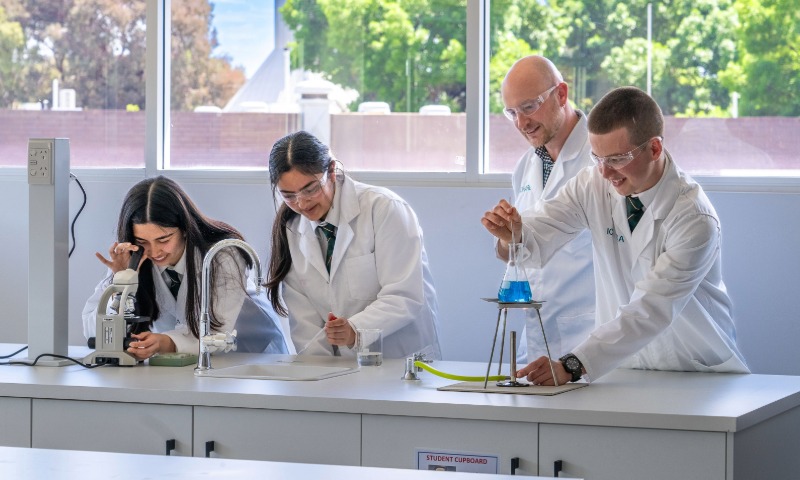
I think that AI will change some of the work teachers do, but it will not remove the need for teachers. If anything, it will make the distinctly human parts of teaching more important. Teachers may spend less time being the sole source of information and more time designing learning, checking understanding, building relationships, giving feedback and helping students use information critically and ethically. The skill will not simply be knowing how to use an AI tool. It will be knowing when it adds value, when it does not and how to ensure the thinking still belongs to the learner.
For Principals, AI will create similar opportunities and responsibilities. It can help us see patterns earlier, reduce repetitive work and connect information across learning, wellbeing and operations. But leadership cannot be automated. Principals will still need to make judgements, understand context, explain decisions and take responsibility for their impact. Our emerging work in Educational Intelligence is built around that balance: using complex information and new technologies to help teachers and leaders act sooner, while keeping the work grounded in learning and viewed through a teacher-leader lens rather than treating the school as a business analytics exercise.
What will differentiate a truly great school from a good school in 2031?
A good school in 2031 will probably have strong facilities, good results and access to the latest technology. A great school will know why those things matter and will use them in a way that remains deeply human. It will know its students well, respond early when they need support, provide genuine pathways and still create a strong sense of belonging. It will not force students to choose between excellence and inclusion. It will understand that excellence looks different for different learners, while still holding high expectations for everyone. It will have effective systems which manage this, and also key people who lead.
A great school will also be able to evolve without losing its identity. It will have clear values, strong leadership at many levels and a culture where evidence leads to better practice rather than simply more reporting. Staff will understand the purpose behind change and students will have real agency in their learning. Most importantly, people will want to belong to the school because they feel known, challenged, supported and able to make a contribution. That is the kind of sustainability that matters more than any individual program or award.
What are the top two books that have fundamentally influenced your thinking on education and leadership?
One book that has influenced my thinking is Michael Fullan’s Nuance. It has helped me more fully appreciate the 360-degree nature of leadership, especially in schools, where everything matters, no matter how small. It helps me reinforce one of my most important values as a leader, presence, and nuancing this to how and where I can be best be present. It helps me understand all of the micro-elements that contributes to leadership in a school, and ultimately leadership of people. There is nuance in everything we do; without recognising it, I still think you can be a good leader, but I aim to be an excellent, holistic and present leader.
The second would be Lee Crockett’s Culture of Excellence. I have found its focus on moving from improvement as a series of activities to excellence as a shared culture particularly useful. It aligns with where my own thinking has moved: destinations need to be clear, but leaders should not pretend they can map every step years in advance. We need to set direction, establish meaningful milestones, listen carefully and respond to what the evidence is telling us. Our 2026 planning work used this thinking to shape the College theme of Embrace your Excellence, and the use of the Destinations, Milestones and Footsteps framework for annual planning.
What is your vision for AI and human-centred leadership working together?
My vision is that AI helps schools become more human, not less. Used well, it can give teachers and leaders earlier insight into where a student may be struggling, where a process is creating unnecessary work or where an opportunity is being missed. That should create more time for conversations, feedback, creativity and relationships. The point is not to replace professional judgement. It is to give professional judgement better information and more space to operate.
Human-centred leadership provides the guardrails. We need to ask not only whether something can be automated, but whether it should be. We need to protect privacy, challenge bias, be transparent about how decisions are made and ensure that technology does not reduce a young person to a set of indicators. AI may help us notice something, but compassion, context and professional courage determine what we do next. The best future is not humans competing with technology. It is technology doing what it does well so that people have more capacity to do what only people can do.
Where do you see yourself in the next five years?
In five years, I see myself contributing to education through leadership, innovation and system improvement. I remain energised by the work of building strong schools, developing people and turning ideas into practices that make a real difference for students. I would like to keep extending that influence beyond one school through a larger influence, whether that is at larger school, or through sector leadership, governance, professional networks and opportunities to share work internationally, while still remaining grounded in the day-to-day reality of schools.
I am less focused on a particular title than I am on the contribution. I want to be in a role where I can continue to connect learning, wellbeing, data, culture and future-focused practice, and where I can help other leaders grow. The next five years should not simply be a repeat of the last five. They should build on what I have learned, test me in new ways and allow me to contribute at a broader level without losing the part of education that matters most: improving the experience and future of young people. I enjoy contributing to and leading the wider narrative of educational leadership across systems.
What is the one message you would give every aspiring educator?
Never lose sight of the fact that this profession is about people before it is about programs, policies or results. Young people may not remember every piece of content we teach them, but they will remember whether we saw them, whether we expected something of them and whether we helped them believe they could grow. Teaching is not about making learning easy. It is about making success possible, then standing alongside students as they do the difficult work required to achieve it.
I would also tell aspiring educators that their influence will often be greater than they realise and less immediate than they might hope. Not every lesson works, not every initiative succeeds and not every impact becomes visible straight away. The purpose is to keep learning, remain curious and continue showing up with both high expectations and genuine care. The profession asks a great deal of people, but there are few roles where the connection between daily work and a better future is so direct.