


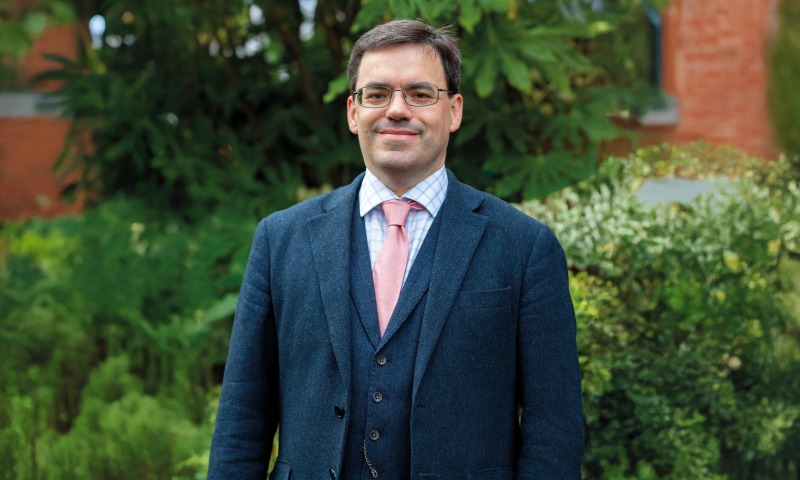
Luke Ramsden is an award-winning Senior Deputy Headmaster and Director of Safeguarding for the St Benedict’s family of schools. In September of this year he is taking up the position of Headmaster at St John’s College, Cardiff. Named NAPCE Pastoral Leader of the Year 2021–22, he has worked with technology companies to develop practical safeguarding software, and he writes and speaks regularly on education leadership, pastoral care, and the ethical use of AI in schools. He also chairs the Schools Consent Project charity and advises the Global Equality Collective among other organisations that he works with.
Recently, in an exclusive interview with K12 Digest, Luke shared insights into leadership, safeguarding, and the ethical use of AI in schools. Looking at AI and wellbeing, he said the next frontier isn’t new tech but answering whether AI will ultimately help or harm young people, balancing its promise for organisation, revision, and pastoral insight against risks of dishonesty, image manipulation, and shrinking attention spans. He also shared his future plans, words of wisdom, and much more. The following excerpts are taken from the interview.
Your career spans some of the most respected schools in the UK, from Ampleforth to Tonbridge to St Benedict’s. How did your early experiences as a teacher of History shape the leader you’ve become today?
I have always found it slightly artificial when people try to draw a sharp distinction between teaching and leadership, as though one is left behind when the other begins. In practice, the habits that make you effective in a classroom are the same ones that determine whether you are any good at leading a school.
My first years in teaching particularly taught me the importance of judgement. In the classroom, you are constantly making small, high-stakes decisions. When to intervene, when to hold back, when to challenge, when to support. That instinct carries through into whole-school leadership, particularly in areas like safeguarding or behaviour, where there is rarely a perfect answer but always a need for timely, defensible decisions.
There is also something about presence. Good teaching is not about performance in the theatrical sense, but it does require authority, consistency and a sense that the room is being held with purpose. The same applies across a school. Staff and pupils notice very quickly whether expectations are real or not. At St Benedict’s, for example, that has shaped how I have approached things like our phone policy or our work on behaviour. Clarity, consistency, and follow-through matter more than the policy document itself.
Finally, teaching keeps you anchored in the day-to-day reality of the school. It is easy in senior roles to become abstract, to think in terms of strategy without testing it against what actually happens in a Year 9 lesson on a wet Thursday afternoon.
What do you love the most about your current role?
What I value most is the ability to change things that matter, and to see that change play out quickly in the life of the school. In the classroom you can have a real effect on the pupils in front of you. In a senior role, you can shape the conditions in which every pupil and every teacher operates. When you get it right, that is genuinely transformative. You see it in very practical ways, like a clearer behaviour system that allows teachers to teach without interruption or a curriculum change or use of technology that gives students more confidence and independence in their learning.
AI is moving from novelty to infrastructure in schools at remarkable speed. Which current trend in educational technology do you think is overhyped, and which is being underestimated?
I think some of the most overhyped elements at the moment are the ones that look impressive on the surface. AI-generated videos, polished presentations, synthetic media. They photograph well, they demo well, and they give the impression of rapid progress. But in most schools they do not meaningfully change how students learn. They risk becoming a layer of gloss rather than something that improves understanding.
What is being underestimated is the much less flashy element of AI. The ability to take a set of class notes and reshape them for a particular student. Simplifying language, adding scaffolding, adjusting the level of challenge, or presenting the same material in a different way. That is not especially eye-catching, but it goes to the heart of what good teaching is. It is differentiation done well, and done consistently.
The reason for the imbalance is fairly straightforward. Schools, like most organisations, are drawn to what is visible and easy to showcase. It is much simpler to demonstrate a striking video than to evidence incremental gains in understanding across a class. Technology companies also tend to prioritise features that attract attention quickly, because that is how products are adopted. The risk is that we focus on the technology rather than the learning. The more useful framing is the opposite. Start with the student. What do they need to understand next, and what is getting in the way. Then use the technology in a very targeted way to address that.
In 2024, you hosted the first Education in AI conference at St Benedict’s, followed by another in 2025. What convinced you that a school, not just a tech company, should lead that conversation?
I felt strongly that this conversation needed to be led by schools because the starting point has to be pupils. Too much discussion around AI begins with the technology itself. What can it do? How impressive is it? How quickly can we roll it out? Those are not the right first questions for schools. The better question is what our students need from us, and how technology can help us support them more effectively.
There is also a need for schools to work together. AI is moving too quickly for each school to sit behind its own walls and try to solve everything alone. We are facing shared questions about assessment, academic integrity, staff training, data protection and pupil use of AI. Sharing good practice is essential to help all our schools move more confidently in this fast changing area.
Leaders are shaped as much by what they read as what they do. Which book has most influenced your philosophy of education, and why does it still sit with you?
The book that has probably stayed with me thinking specifically about education leadership most is actually Langley Sharp’s The Habit of Excellence. It is not a conventional education book, which is partly why I have found it useful. It looks at British Army leadership, but the central idea has real relevance for schools. In simple terms, the best organisations (in this case talking about the arm) are not those where every decision is referred upwards. They are organisations where the people closest to the situation understand the purpose, values and direction so clearly that they can act with confidence and judgement without constantly needing permission.
That matters enormously in schools. A good school cannot be run by senior leaders trying to control every interaction. It depends on teachers, tutors, heads of year, support staff and middle leaders making good decisions every day. They are the people in the classroom, in the corridor, on the trip, in the difficult pastoral conversation. If they understand the ethos of the school properly, they should be able to respond in a way that is consistent with what the school stands for.
For me, that is one of the central tasks of leadership. Not to create dependency on senior leaders, but to create alignment. Staff need to know what matters, why it matters, and where the boundaries are. Within that, they need trust and freedom to act. That has shaped the way I think about education. A school with a strong culture should not need a rule for every possible situation. It should have adults who understand the mission well enough to apply it intelligently.
History teachers often have a favourite era or figure they return to. Which period of history do you find yourself drawing on most when talking to students about character?
Rather than looking at one particular period what interests me most about the past is the evidence we have for ordinary lives, from modern diaries and letters all the way back to ancient papyrus fragments from Egypt. There is a danger in teaching history that character becomes attached only to the great political and military figures. Kings, generals, revolutionaries, emperors. Of course they matter, but they can also make history feel remote. When students encounter ordinary people, the distance often collapses. They see people worrying about their families, complaining about work, making jokes, trying to do the right thing, falling short, recovering, showing loyalty, courage or generosity in small ways.
That is where I think character becomes most teachable. Not as a list of abstract virtues, but as something lived by people who were not so different from us. A Roman soldier writing home, a Victorian child describing school, a twentieth-century diarist trying to remain moral in terrible circumstances. Again and again, you find humour, irritation, affection, duty, guilt, hope and a recognisable sense of right and wrong. So I tend to draw on the lives of ordinary people across history, rather than one favoured age. They remind students that the past was not inhabited by a different species. It was full of people like us, making choices under pressure. That is usually where the most useful lessons about character are found.
St Benedict’s is now seen as a leading voice on ethical AI in schools. What’s the next frontier you want the school to explore with technology and wellbeing?
I am not sure I am looking at the next frontier because there is so much to do where we are in our current thinking about technology and wellbeing. The ongoing central question is whether AI will, on balance, be good or bad for the wellbeing of young people, and at the moment, I do not think anyone can answer that confidently. There is obvious promise. AI could help pupils with organisation, confidence, revision, feedback, accessibility and personalised learning. It can also help staff notice patterns earlier and respond more intelligently to pastoral need. But there are also so many risks, ranging from academic dishonesty through to image manipulation and the worry that AI will further reduce attention spans. This continues to be work then of all schools, and wider society of course, to ensure that AI is being used ethically and can be used to promote wellbeing.
Where do you see yourself in the next 5 years?
I have an exciting 5 months ahead of me in fact, as I move from Ealing to be Headmaster of St John’s College in Cardiff. In five years, I hope I will be fully settled into my role as Head of St John’s, and that the school will be even more thriving and confident than it is at present. St John’s is a very special school. It has an excellent academic reputation, a long musical tradition as the Catholic cathedral choir school, a strong sense of community, and the kind of scale where you can really know pupils and families properly. I am looking forward to settling in Cardiff and getting to know this new community and hopefully it will be sooner than five years before I can drop a little Welsh into conversation without causing too much alarm!
Aspiring leaders read these interviews for direction. What advice would you give to a Head of Department today who wants to shape whole-school culture tomorrow?
I would say start by leading your own area exceptionally well. Whole-school culture is not shaped by people who talk impressively about leadership while their own department is inconsistent. It is shaped by people who build trust, set clear standards, support colleagues properly, and show that pupils can thrive under their care. A Head of Department has more influence than they sometimes realise. They shape curriculum, expectations, staff morale, pupil confidence and the daily habits of learning. If they do that well, they are already contributing to the culture of the whole school.
Become known as someone who improves things without creating drama. Be clear, be reliable, notice what is not working, and do something practical about it. Senior leadership is not a different species of work. It is the same habits applied at a larger scale.