



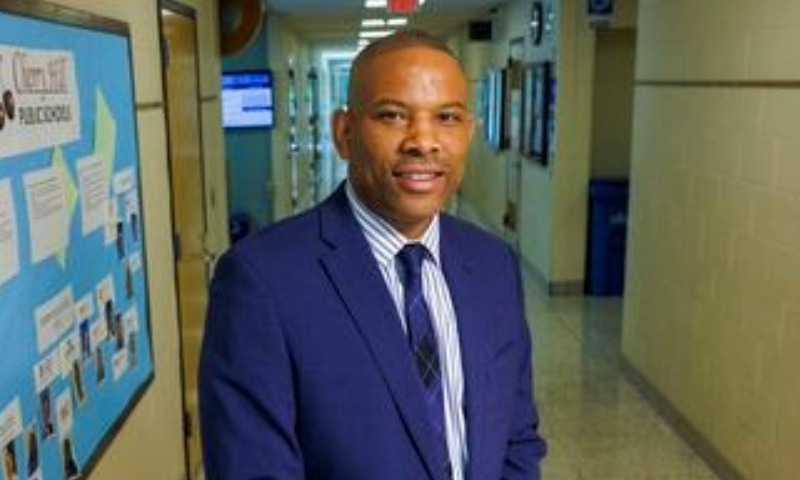
Dr. Kwame R. Morton is the Superintendent of Cherry Hill Public Schools in New Jersey and the 2021 NJ Visionary Principal of the Year. A systems thinker with 30 years of experience, he has served in leadership roles across New York City, Philadelphia, and Cherry Hill, including as a National Turnaround Specialist. He holds an EdD in Educational Leadership from NorthCentral University. A former standout basketball player at Clarion University of Pennsylvania, he was named the Basketball Times 1994 NCAA Division II Player of the Year. He and his wife April are the proud parents of 10 children and two grandchildren.
Recently, in an exclusive interview with K12 Digest, Kwame shared insights into how his professional journey began with others believing in him as a maths teacher in NYC, experiences that propelled him from assistant principal to superintendent over a 30-year career. He sees AI as the biggest shift ahead for K-12, envisioning it as an adaptive tool that lets teachers differentiate learning at scale while redefining student success beyond test scores to critical thinking, creation, and collaboration. His words of advice for new educators: know your why and protect it — that purpose sustains you through hard days and keeps the work meaningful. The following excerpts are taken from the interview.
Hi Kwame. Every leader’s path starts in a classroom. Looking back at your 10 years as a teacher and administrator in NYC, what moment made you realize education leadership was your calling?
My journey into educational leadership was one rooted in others believing in me. I enjoyed every aspect of being a teacher at Public School 288 in District 21 of the NYC Department of Education, where I taught 4th grade and 6th through 8th grade mathematics. Our Superintendent of District 21, Mr. Donald Weber, was the first to communicate his belief in me as a future administrator. He was a legendary figure throughout the district, and along with my principal at the time, Mr. Bruce Wallach, he communicated to me that I embodied the qualities necessary to be a great administrator. Mr. Weber provided me with the opportunity to move to Public School 188, where I was ultimately appointed as assistant principal. It was a tremendous accomplishment, as I was someone who had grown up in that community and was now stepping into a leadership role within it. It was the first time something like that had happened there. Ultimately, having others believe in me confirmed my belief in myself and accelerated my movement into school administration sooner than I had anticipated.
What do you love the most about your current role?
I have served as an assistant principal at both the elementary and high school levels, as a principal of a PreK–8 building, a K–5 building, and at the high school level, and as an assistant superintendent. All of those roles have prepared me for where I stand today. As superintendent, I have the ability to create the conditions that help students succeed. I hold the greatest vantage point in the organization, one where I regularly interact with dynamic students, a dedicated faculty, and passionate families. Serving as Superintendent of Schools for Cherry Hill Public Schools is a genuine honor, one that allows me to make system-wide impact through a collaborative framework every single day.
K-12 education is changing fast post-pandemic. In the next five years, what will change most about how students learn and teachers teach?
Undoubtedly, the emergence of AI as a viable avenue for teaching and learning will drive the most significant change in education. The rapidly growing capabilities of AI platforms suggest that there are ways it will impact teaching and learning that have not yet been fully realized. I envision a future where educators are utilizing AI as an adaptive learning tool, one that allows teachers to differentiate learning opportunities for students across the entire curriculum in ways that were previously impossible at scale.
You’ve led curriculum and instruction PreK-12. How will the definition of “student success” evolve beyond test scores by 2030?
The emergence of AI and associated technological tools has prompted educators to redefine the role of the teacher, shifting from one who distributes knowledge to one who guides students in deciphering and applying the vast knowledge that already exists to solve complex, as-yet-unsolved problems. Consequently, the acquisition of knowledge and the demonstration of its recall will no longer be sufficient measures of success. The reality is that knowledge exists and is readily accessible and retrievable by all. By 2030, student success will increasingly be defined by how students interact with knowledge in new and innovative ways, including their capacity to think critically, create meaningfully, and solve problems collaboratively.
Mental health and belonging are now central in schools. What capability will separate districts that support students well from those that struggle?
Supporting students with mental health needs has become a prerequisite to learning. As such, a deep understanding of how the brain works and responds to trauma is essential for every educator. Understanding concepts such as the “amygdala hijack” and, more importantly, implementing strategies to prevent it from occurring is of critical importance. Districts that fail to build this capacity will struggle with lagging achievement outcomes and persistent challenges related to students’ sense of belonging. Those that invest in it will create the safe, stable environments where real learning can take place.

You mentor aspiring leaders. What’s the most common gap you see in new administrators and how can they close it early?
New administrators often believe that heroic leadership, the kind centered on one individual’s efforts and vision, is the preferred model for achieving sustained success. Experience has taught me otherwise. Heroic leadership may produce results in a given moment, but it rarely leads to systemic improvement that can be sustained in the leader’s absence. What matters far more is the ability to build sustainable, collaborative systems that empower others to lead as well. The true measure of a great leader is not what they accomplish alone, but their ability to make those around them great.
School leaders need energy outside the building to sustain impact inside it. What book, not about education, has shaped how you think about people and leadership?
Outliers by Malcolm Gladwell has had a profound impact on how I view people and leadership. Schools tend to sort and rank students in ways that create false presuppositions, suggesting that intelligence and success are innate, fixed qualities. Gladwell challenges that notion compellingly, arguing that there are very few true outliers in society and that success is, in most cases, a combination of opportunity and deliberate practice. This aligns beautifully with brain research on neuroplasticity and the capacity of individuals to continuously learn and grow. It is an outstanding book that I recommend not just to educators, but to anyone invested in understanding human potential.
Many leaders have a signature question before making big decisions. What’s the one question you ask yourself about kids before making a call?
This one is simple and consistent for me: “How will this decision impact the health, wellness, and academic success of my students?” Every significant decision I make passes through that filter first.
Where do you see yourself in the next 5 years?
This year marks my 30th year in education, and I am as energized and committed today as I was when I started. Over the next five years, I see myself continuing to grow as a leader and expanding my impact on students, deepening the work of building systems that serve every child well and leaving a legacy that outlasts any single role or position.
For aspiring teachers and principals entering education today, what one piece of advice would you give that you wish someone told you at the start?
Know your why and protect it. My why has never changed across 30 years, from classroom teacher to assistant principal, principal, assistant superintendent, and now superintendent. I entered this profession because I love children and feel genuinely called to the purpose of helping them access the life they aspire to live and fulfill their deepest personal and family goals. That clarity of purpose is what sustains you through the hard days. When you are anchored in your why, the work never loses its meaning and watching students succeed never, ever gets old.