



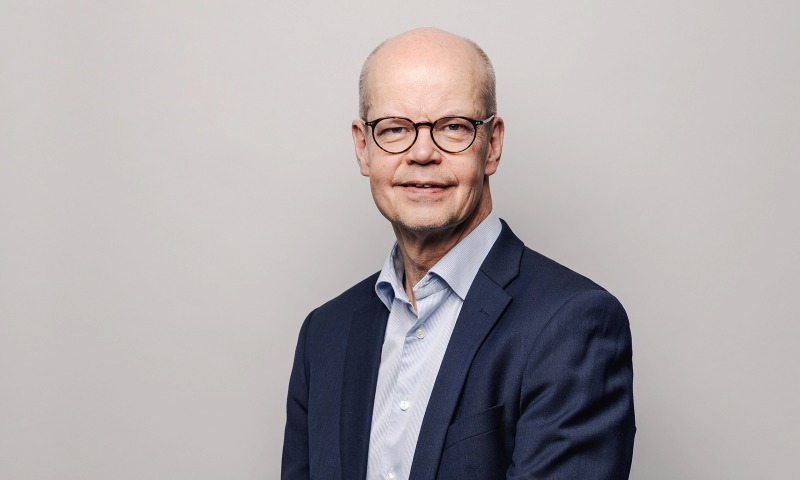
Olli-Pekka Heinonen has served as Director General of the International Baccalaureate (IB) since 2021, advancing its mission to develop inquiring, knowledgeable, and caring students. Mr. Heinonen served as Director General of the Finnish National Agency for Education from 2016-2021. Prior to that he served as State Secretary to the Finnish Prime Minister and as Minister of Education and Science.
The issues that will define this generation do not sit neatly within classic school subjects.
Climate change is not only a geography problem. Inequality is not only a politics problem. The effects of technology on democracy are not only a computer science problem. Each one is a systems problem: one in which causes and consequences are spread across disciplines, institutions, and borders, and where acting on one part of the system invariably affects everything else.
Secondary education has been aware of this for some time. The response, in most models, is to teach systems thinking at the edges. What has been missing is the willingness to commit fully to this kind of learning and to treat it with the same rigour we apply to mathematics or literature.
That is why in May the IB’s Board of Governors approved the next step for Systems Transformation, a new IB Diploma Programme course now moving from a small pilot toward a wider early adopter phase in 2028 before a planned global offering in 2030.
Systems Transformation is a significant addition to the DP. It emerged from a question the IB has been sitting with since 2019: what else might students in their last years of secondary school need that the DP can provide?
This question prompted a careful review of the IB’s offering for the 16-18 age group, shoring up what works and identifying where new opportunities could take root and grow. The DP itself has been an evolving fixture of the IB since 1968, and is one of the most rigorous and respected pre-university qualifications in the world.
The review eventually presented us with two opportunities for new course offerings: engaging with data, which will be addressed through a companion course currently in development, and systems thinking, which Systems Transformation is here to meet head on.
Systems Transformation is not just about systems thinking in the academic sense. It is important that students understand how systems work, but they also go beyond this by putting that learning into action. Students are designing and carrying out interventions in systems which are very much real.
Students learn to map stakeholders, trace how a change in one part of a system ripples through others, and work in teams to test their ideas. They learn to embrace complexity over simple solutions, take greater ownerships of their learning, and ultimately, to act. The course is transdisciplinary by design: the problems it addresses do not respect subject boundaries, and no single subject can claim clear ownership.
In another first for the DP, Systems Transformation counts for two standard-level courses in the IB’s six-course requirement, carrying 14 of the 45 available points (double the usual seven). In place of traditional exams, students are assessed through a range of authentic formats that reflect the action-oriented nature and real-world focus of the course. In the pilot, this has included tasks based on projects, portfolios and case studies.
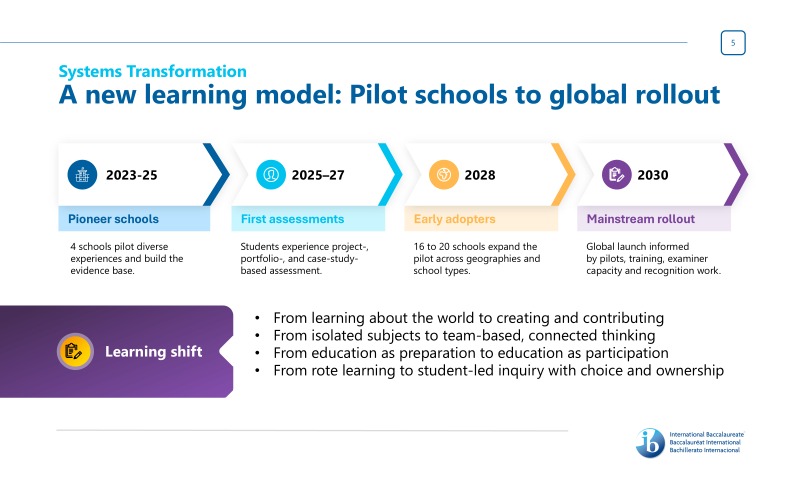
Four schools are currently piloting the course: UWC Atlantic in Wales, UWC Southeast Asia in Singapore, Upper Canada College in Toronto, and Mulgrave International School in Vancouver. This May, 100 pilot students sat the formal assessment for the first time.
The work they have produced spans subject disciplines as well as geographical locations, from the next town over to the other side of the world. One student is tackling energy poverty in Kinshasa, converting food waste from local restaurants, farms and educational institutions into biogas, then running workshops to teach communities how to sustain the system themselves. Another is working with one of Nepal’s first community seed banks to run workshops for farmers and high school students on alternatives to chemical fertilisers and imported seeds.
One Systems Transformation student worked with a group of elderly migrant women in Malmö, Sweden, to address the isolation that comes with discrimination, language barriers and exclusion from community life. And in northeast Brazil, one student designed a sticker album for children in the semi-arid biome of Caatinga, with cards of increasing rarity featuring more endangered species. The student hopes that, if children feel they belong to the biome, they may be more likely to protect it.
These projects vary in scale and subject matter. Each student has identified a system with which they have a sincere connection, studied it carefully, and then found a point of genuine intervention. That combination of analysis and action, of rigour and real-world consequence, is precisely what Systems Transformation is designed to produce.
From 2028, more early adopter schools will offer the course, drawn from a wider range of contexts spanning countries, languages, and state-maintained schools. We hope to achieve mainstream availability in 2030, with the first mainstream cohort graduating in 2032.
We expect growth to be gradual, and will offer professional learning opportunities to support teachers in shifting to this focus on systems. Nearly 4,000 schools around the world offer the DP, each offering their own combination of diverse DP subjects. Systems Transformation will take its place among this broad academic offer, with every diploma awarded reflecting the diverse and exciting ambitions of the graduating IB student.
Systems thinking has been embedded in university programmes and professional practice for decades. It is how policymakers, ecologists, and business leaders have learned to approach problems too complex for single-discipline solutions. What has been missing is a recognised secondary-school route into this kind of learning, within a qualification universities already understand.
Systems Transformation will provide that route, giving students a recognised path to do what the world will soon demand of them: understand complexity, act with judgement, and contribute to meaningful change.