



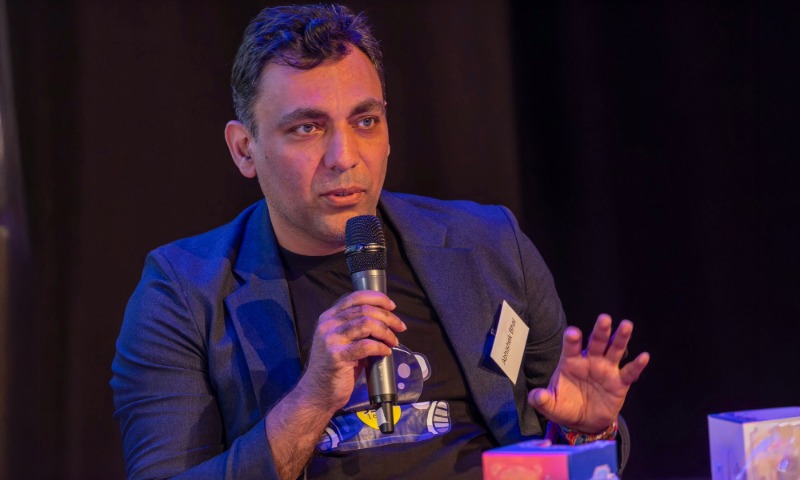
Abhishek Bahl is the Founder of JetLearn, a fast-growing online AI academy for kids and teens. JetLearn empowers the next generation with future-ready skills in Artificial Intelligence and Robotics, delivered in a fun, personalized, and inspiring way that encourages learners to use technology as a force for good. With students across continents—and dedicated programs for girls and neurodiverse learners—JetLearn’s mission is to ensure an equitable AI-first world.
An alumnus of IIT Kharagpur and INSEAD, Abhishek’s career spans more than two decades across Silicon Valley, Europe, and India, where he has led global product innovation, expansion, and advanced technology initiatives. He holds patents in Artificial Intelligence, has scaled three global startups, and serves as an educator and mentor at INSEAD. Through JetLearn, Abhishek is on a mission to spark curiosity, confidence, and creativity, helping the next generation unlock the superpowers of AI—regardless of geography or background.
Recently, in an exclusive interview with K12 Digest, Abhishek shared insights into how JetLearn is reimagining STEM by fixing what’s broken in traditional tech education for kids. Looking five years ahead, he believes the real divide in edtech will be between platforms that simply digitize worksheets with AI and those that rebuild learning around creation, deep personalization, and teaching kids how to think. Equity drives JetLearn’s mission, and Abhishek stresses that AI narrows gaps only when implemented intentionally: personalized pacing for neurodiverse learners, access paired with mentorship, and inclusion designed in from day one. If every JetLearn student saw one sentence at login, it would be “Don’t just use AI—build with it,” inspired by Richard Feynman’s belief that creation drives understanding. The following excerpts are taken from the interview.
Hi Abhishek. With robotics and AI delivered in a fun, personalized way, you’re reimagining STEM. What was broken in traditional tech education for kids that JetLearn set out to fix?
Traditional tech education for kids has been stuck in a few limiting patterns for years.
First, it was passive – focused on theory and syntax rather than building real things. Kids were learning about technology, not how to think with it.
Second, it was one-size-fits-all. Every child learns differently, but classrooms move at a fixed pace, leaving some behind and others unchallenged.
Third, it was outdated. With AI evolving so quickly, most curricula simply can’t keep up.
At JetLearn, we flipped this. Learning is hands-on, personalized, and relevant. Kids don’t just use technology – they build with AI, solve real problems, and develop the confidence to navigate an AI-first world.
You’re teaching AI to kids at global scale. Five years from now, what will separate edtechs that transformed learners from those that just digitized worksheets with AI?
Five years from now, the difference will be simple.
Most edtechs will use AI to digitize and automate learning – better worksheets, faster feedback, more scale. But the core experience won’t change.
The ones that truly transform learners will rebuild learning around AI – focused on creation, deep personalization, and teaching kids how to think, not just use tools.
At JetLearn, we believe AI should make kids more capable, not just more efficient. The real divide will be between platforms creating users of technology and those shaping creators of it.
Equity drives JetLearn. How should school leaders ensure AI narrows learning gaps for neurodiverse and underserved students, instead of widening them?
Equity with AI has to be intentional-it won’t happen by default. JetLearn has partnered with UK charity Skylarks to design programs for learners with additional needs – these program have been recognized with multiple awards in the UK.
First, use AI for true personalization, adapting to each child’s pace and learning style, especially for neurodiverse learners.
Second, ensure access with support – not just tools, but guidance and mentorship.
Third, design for inclusion from day one, with multiple ways to learn beyond text.
Done right, AI can narrow gaps. Done passively, it widens them. The difference is in how it’s implemented.
Girls’ participation in tech is a priority for you. How should K–12 leaders use AI to strengthen agency and STEM identity for girls without reinforcing bias?
If you walk into most classrooms, girls are using technology – but not always seeing themselves as builders of it. That’s the gap.
It starts by shifting girls from users to creators – building with AI, not just consuming it. Then, ensuring what they see reflects diverse role models, not stereotypes. Add to that early confidence through small wins and personalization, and the impact compounds.
And importantly, teach them to question AI, not just use it.
Because this isn’t just about participation – it’s about helping girls see themselves as the ones shaping technology.
Founders are shaped by what they read. What book on technology, learning, or human potential has the most notes in your margins, and which idea from it lives in JetLearn’s pedagogy?
One book that has had a lasting influence on me is Mindset by Carol Dweck, because it fundamentally changed how I think about learning and potential.
The idea that stayed with me is that intelligence is not fixed — it expands through effort, experimentation, and persistence. That belief is deeply embedded in JetLearn’s pedagogy. We want children to see challenges not as proof of limitation, but as part of the learning process.
So instead of optimizing for memorization or perfect answers, we focus on building, iteration, and creative problem-solving. Whether students are creating AI apps, games, or robotics projects, they learn to debug, adapt, and keep improving. In a world where technology evolves constantly, teaching kids how to learn — and how to stay curious through difficulty — is far more important than teaching static knowledge alone.
Many professionals want to build in education and AI. What skill do aspirants consistently undervalue until they try to teach kids?
The most undervalued skill is the ability to engage.
When you teach kids, especially in something as complex as AI, you realize very quickly—if you can’t make the content and delivery engaging, it won’t lead to learning outcomes.
In today’s world, where content generation has become easier and faster, what really matters is the ability to engage which leads to motivation which in turn leads to learning.
If you could put one sentence on the login screen of every JetLearn student, what would it say and whose words are they?
“Don’t just use AI—build with it.”
It’s a line we often repeat internally, but it’s inspired by the spirit of Richard Feynman—what I cannot create, I do not understand.