



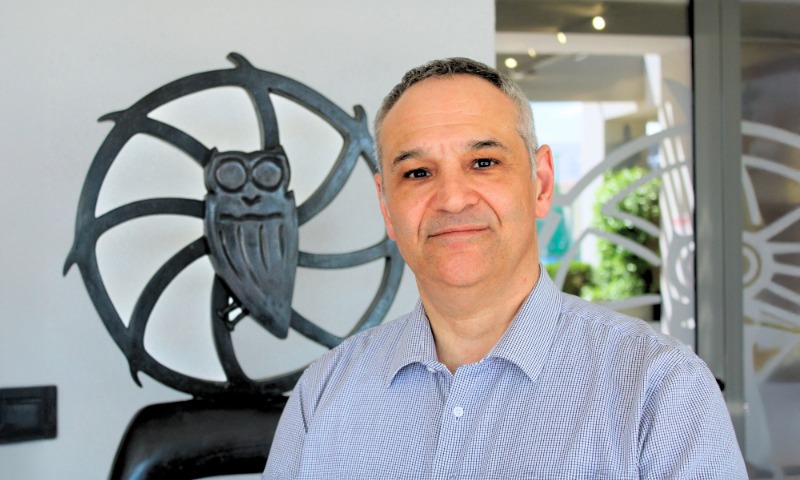
Sacha van Straten is an award-winning educator and change agent with a track record of innovation using digital solutions. After an award-winning radio, TV, web TV, and interactive TV career, Sacha moved into education. In his current role as a senior leader delivering digital innovation, he explores how digital strategies can improve the learning experience for students and staff, using AI, curiosity and metacognitive capture to reframe assessment, learning outcomes, and business practices.
Sacha holds an MA in Computing Education from King’s College London and is a certified Apple Teacher and Microsoft Innovative Educator Expert (focusing on AI development). A founder member of Google UK’s ‘Innovators in the Cloud Education group’ he has presented at the BETT show in London, as well as the Independent Schools Council digital conference. He is an ambassador for Canva, and a member of the 2026 Toddle Global Advisory Council. Sacha is the Head of Digital Innovation at St Catherine’s British School in Athens, Greece.
Recently, in an exclusive interview with K12 Digest, Sacha shared insights into how his journey from award-winning radio, TV, and interactive media into K–12 education shaped his belief that pedagogy trumps technology at every turn, and that digital tools succeed only when deployed with purposeful intent inside a considered governance framework. He noted students are already creating AI-powered YouTube channels, publishing books via Kindle Direct Publishing, and acquiring entrepreneurial skills schools don’t teach — making it vital to amplify authenticity, creative integrity, copyright awareness, and productive struggle so AI doesn’t narrow the “novel ideas gene pool.” The sentence he’d project in every staff meeting is his own: “The person in the chair must be the expert in the room,” a reminder that AI assists cognitive skills, never replaces them. The following excerpts are taken from the interview.
Hi Sacha. Your path bridges communications, computing, and the classroom — from MA in Computing in Education to award-winning multimedia work. What first showed you that digital tools could change how a child learns, not just how a school runs?
In education, it is always about learning first. I would challenge the view that digital tools are seen only as instruments for school administration. We live in a world where everything has contact with digital practice. From a learning perspective, pedagogy trumps technology at every turn. My previous career in the media taught me the importance of building relationships. Humans are social animals and finding common ground opens up opportunities for communal growth. Technology, used with purposeful intent inside a considered governance framework, can empower that. Learning tools deployed to satisfy a desired image without planning for the context and culture within which they will operate, are doomed to fail.
Over the years I have had many ‘wow!’ moments.
Many years ago, I was asked to teach a class of Year 8 students English for a year. The department at Berkhamsted School had seen what I was doing in Media Studies, building cross-curricular digital literacy skills. They wanted to set me loose to discover what would happen. My first degree is Classics, so there was also an element of wanting to observe how someone with a strict grammatical background in Latin and Ancient Greek would tackle contemporary English. This is going back to 2008 when smartphones had not fully emerged. I bought some cheap mobile phones without SIM cards and connected them via Bluetooth to my school laptop. I got the students to try writing haiku poems on the phone, then send them to me. It was a powerful way to demonstrate the importance of register in language, while exploring how form impacts function. It made a change from writing on paper and helped students reflect on technology’s impact on communication.
More recently, I have been wowed by Canva Code. Canva is an incredible design platform that’s transforming into a powerful learning ecosystem. The team at Canva are working hard to provide educational tools that teachers and students can use. Their use of AI is designed for younger students, and it’s become one of my go-to tools for impactful learning. It enables students to have authentic experiences of bringing their ideas to life, with AI that assists rather than completes their vision. Canva Code launched last year and has unleashed remarkable opportunities for students to produce complex websites and apps. I entered teams into the world’s first student Canva Code competition and was delighted that two of them won awards. A group of Year 8 students from Merchant Taylors’ Prep came third overall, with an app that used multiple simulations to show how changes to the environment impact our oceans. They also built an app where the user can dive into the depths and learn more about the marine life that lives there. It also had a quiz and a chatbot. These are 12 year olds, and they built all of this, including writing the design specification, in two one-hour lessons. A pair of Year 6 students won the inclusion award. They built an app that places the user in the shoes of the Nigerian president. You are presented with increasingly complex challenges to address in real-time. You play until the money runs out. These Year 6 students built accessibility tools, to help those with dyslexia and vision impairments. It’s incredible what young people can create, when given the chance and the tools to bring their thinking to life.
What do you love the most about your current role?
I joined St Catherine’s British School in Athens last January as its first Head of Digital Innovation. It’s a warm and welcoming school with high aspirations for students and staff. We have four core values that are dear to my heart: care , integrity , curiosity , and dedication. There’s a real buzz to the school, with a genuine curiosity about how digital technology, and AI in particular, can be a force for positive change. I’ve spoken to multiple year groups, co-taught a Science project using Google’s NotebookLM, explained the dangers of deepfakes to Year 9, and addressed our IB Senate on how we can give students safe and equitable access to AI tools. The parents I have spoken to are keen to understand how the digital experiences they encounter at work can be mapped to safe learning environments for their children.
I’m also working with our support teams to streamline school operations, using AI to assist us in assessing and refining how we function. It’s a wide-ranging role that covers everybody within the organisation. There’s a shared dedication to giving everybody, staff and students, the best opportunities possible. I love the fact that I get to channel my curiosity about the rapidly changing world we inhabit, with a brief to plan for now and the future, using ethics and pedagogy as my bedrock for careful and transparent deployment.
Whole-school digital learning is now mainstream, yet AI is rewriting what “digital” means. Five years from now, what will separate a school that’s transformed by AI from one that’s just digitized?
We’re seeing the digital divide expand already. Tools like ChatGPT or Claude require increasingly expensive subscriptions. We have bought Google Workspace for Education Plus accounts for everybody. That brings a wealth of integrated AI-powered tools into the hands of teachers, students and administrators. The cost is not huge for what is provided, but it is a cost. Not all schools can afford it. The pace of change is remarkable. This is my twenty-fourth year as an educator. I cannot remember a time when digital capabilities improved at such a pace. No school can embed AI into its curriculum, or its culture, without explicitly deciding how the tools support the values and aims of the institution.
At St Catherine’s, the Principal, Jon Perriss, reminds us that we seek ‘excellence in every interaction.’ The smallest of details can have the biggest of impacts. Jon likes to point out that a rising tide lifts all boats. When it comes to the vision, strategy and policies I am writing, that translates into anchoring the tools with the why and the how of our values and ethics. I know schools where senior leadership are waiting to see what will emerge. That is not a good strategy. Students are using AI already. We need to provide the moral framework that enables them to see AI as a learning tool, not a thinking replacement. Schools that fail to put in the governance foundations now will find themselves adrift, as AI embeds further and deeper into the curriculum and day-to-day life.
Media Studies and Computing are both subjects you teach. What trend in how students create, not just consume, media should schools amplify now?
I have not taught Media Studies since 2012, focusing instead on the delivery of Computing from Key Stage 1 to Key Stage 3. In my current role I do not have a teaching timetable. I drop in to co-plan and co-teach lessons across the school. I have noticed that skills which previously were constrained to older students receiving academic lessons are now learnt independently by younger pupils.
I had a fascinating conversation last year with a thirteen year old student. He had a particular interest in Americana and loved all things technological. With support and oversight from his parents, he started an AI-powered headless YouTube channel. This means there is no visible presenter in the videos. He used AI to help him produce scripts for his videos and generate an AI created voiceover. Quickly, he acquired a decent following and was able to generate money through adverts. I must stress his parents were overseeing all of this – he wasn’t old enough to set up the financial elements. After that, he was curious to see what self-publishing a book would be like. So, he used AI to help him write some guides to videogames he liked. He used Amazon Kindle Direct Publishing to promote and distribute it. He had some sales, and it taught him a huge amount about how to plan, produce and distribute content. These are not skills we teach directly in school curricula, but increasingly these are the skills our students are acquiring on their own.
It’s wonderful that such creative and entrepreneurial opportunities are available beyond the school boundary, but they come with risks of not knowing about authorship, copyright, creative integrity, and the ethical use of AI. Schools need to consider how they can adapt what experiences students have, to prepare them for a world where creativity can be harnessed without the need for hundreds or thousands of hours of practice. If everything seems easy, the risk isn’t only an excess of AI Slop. There’s the distinct possibility that key creative disciplinary practices are lost.
Throughout human history, those who innovate are the ones who analyse the rules or social norms, question them, and create an alternative. AI feeding on AI may narrow the novel ideas gene pool. That is why it is vital schools promote and amplify the necessity of authenticity in the creative process.
To link today with my media past, when I began working in radio, we recorded on tape. I would edit by marking cut points with a chinagraph pencil, slicing the tape with a razor blade, followed by stitching using sticky tape. Now, an editor presses Copy, Paste, or Undo on a keyboard. The freedom to experiment can be both liberating and distracting. Sustained focus and attention to detail in digital production are skills schools should explicitly encourage, as well as copyright, deepfakes et al. Students need to experience productive struggle to reinforce the importance of human contribution.
Our students are learning without us. We need to catch up. I encourage schools to review where the uniquely human traits appear in the learning process. Amplify them to give young people a fair chance of navigating the future with success.
Co-curricular life is where culture lives. What trend in blending digital and co-curricular experiences is most promising for student agency?
A student with a great idea is no longer limited to holding it in their imagination. They can bring whatever they can imagine to life. Apps like Canva make podcasting accessible and easy. The same is true for screen recording programs. I like to get students to make fly-through videos of their projects. Hearing their voices describe the development of ideas and the progression from idea to delivery reveals far more about their thinking and state of mind than a written report only. Before we dismiss the idea of content creators, I think it is important to consider that multimodal communications have the power to spark interests in students who would otherwise not discover them, if they were in a more traditional format. We forget how liberating it could be for students to produce complex content, about ideas that fire up their passions, without recourse to large crews, expensive kit, and time-consuming location trips. Yes, we need to be mindful of copyright and human agency, versus AI-only generated content, but the bigger picture is exhilarating.
My most popular clubs have been Minecraft Education based. An outside observer might look into my classroom and see noise and excitement. What’s actually happening is the development of key life skills. Students are debating and agreeing on game rules, deciding who will enforce them, which teams do they make, depending on respective skills (design, building, coding, game strategy, etc.). They are working out a shared language for communication in different scenarios. They are thinking under pressure about what types of collaboration work best. The students decide all of this. My role is to be the arbiter when teams get stuck, and show students communication or practical tools that help remove obstacles. It is learning, but within a less structured environment.
Books shape how we think about learning and media. What book on education, computing, or storytelling has the most notes in your margins, and why?
Matthew Wemyss is a teacher who has made a mark with his thoughtful and visionary uses of AI in education. I have all of his guides, written for both teachers and students. Matthew also runs the successful AIDucation conference from his school in Bucharest. He is always a solid source of excellent information. I am about to start annotating his latest book, Every Teacher, Every Subject: A Practical Guide to AI Literacy Across the Curriculum.
Amelia King’s book, Thinking With AI, is another well-thumbed book in my collection. Amelia is superb at challenging educators to think about what we are teaching, why we are teaching it, and the unavoidable pace of change, now that AI is infusing every classroom.
Dan Fitzpatrick has made a global name for himself as a strategic visionary when it comes to AI at the whole-school level. He publishes a new guide each year, co-written with educators working at the cutting edge of AI in education. I have my copy of The AI Educators’ Guide 2026 on my desk. I refer back to his book, Infinite Education: The Four-Step Strategy for Leading Change in the Age of Artificial Intelligence, on a regular basis.
Laura Knight is someone I have known for almost twenty years. Her skill in enabling schools to plan strategically for well-being in a digitally connected world is unmatched. She has one book out that is superb as a brief guide for schools looking to train staff in generative AI. It’s called A Little Guide for Teachers: Generative AI in the Classroom. She has a new book coming out next year. Its working title is Raising Humans To Flourish In An AI World – A Parenting Guide to Childhood and Digital Thriving. I’ll be sure to order a copy as soon as it is published.
Lastly, anything by the inspirational father of British Ed Tech, Al Kingsley MBE, is a must-read. I can recommend his latest offering, The Awkward Questions in Education: The Elephants in the Room from AI to Teacher Retention. Al is brilliant at seeing the details in the larger picture, drawing together disparate threads that build the tapestry of education into a tangible image for progress. Anything he writes comes highly recommended.
As an award-winning photographer and filmmaker, you see frames others miss. What image you captured — still or moving — taught you the most about teaching?
I have many photos taken over the years where students are huddled around a tool for learning – that could have been a drone, a programmable trainset, or running a mixing desk. There’s a common thread that appears in all of them. The students are in a state of flow, totally focused on the task they are doing. Most importantly, there is eye contact, communication and collaboration visible. It’s that human element that makes teaching the most wonderful profession in the world. It brings together people with disparate interests, who are learning about themselves, the culture they inhabit, and what motivates them to be better today than they were yesterday. Humans are social animals, and schools are so much more than places where curricula are delivered. They’re a living laboratory for personal improvement. We have four core values at St Catherine’s: Care, Dedication, Integrity, and Curiosity. No machine can replicate those. They need human connection and involvement to create well-rounded global citizens who can make the world a better place.
Where do you see yourself in the next 5 years?
I arrived at St Catherine’s British School in January. It’s an amazing school that’s committed to a journey of sustained evolution. I see myself still here, enjoying living in one of the most famous capital cities in the world, creating new opportunities with emerging technologies for teachers and students to think, engage, and create. We’re looking at workload, assessment, creativity, and how we can develop curious and independent-minded citizens of the world. To be part of a team that’s looking ahead and building for the future is a remarkable privilege.
If you could project one sentence onto the screen of every staff meeting, what would it say and whose words are they?
‘The person in the chair must be the expert in the room’. It’s a phrase I use with my students, to remind them that AI is a tool that helps them develop cognitive skills, not replace them.