



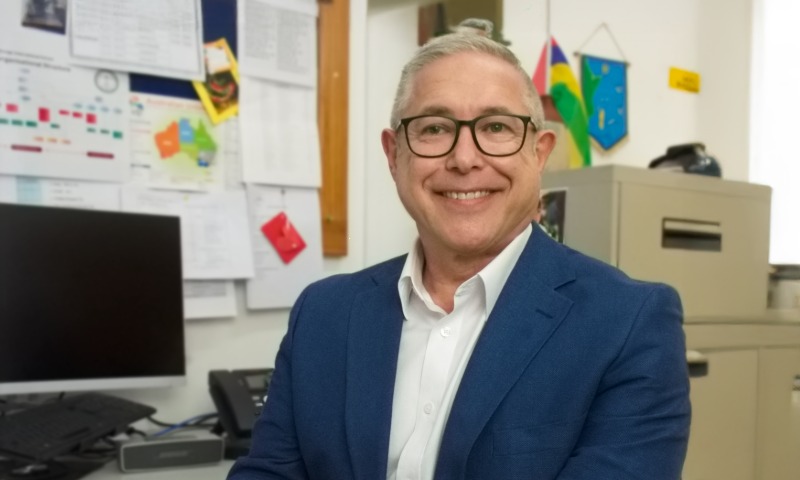
Dr Nigel Winnard is an experienced international school educator, leader, researcher, and consultant with more than 20 years of headship experience. He founded Sudan’s first IB World School and served as Head of the American School of Rio de Janeiro, leading its transition to a two-campus IB World Continuum School. He is currently Head of School at Le Bocage International School, the oldest IB World School in Mauritius.
“The highest honor on Earth that you will ever have is the honour of being yourself.”
– Oprah Winfrey
At first glance, Oprah’s statement feels disarmingly simple, almost sentimental. But in the lived reality of international education, it becomes something altogether more demanding. The honour of being oneself, as she puts it, is not bestowed easily. It is earned through daily calibration, a balancing of moral integrity and contextual awareness that rarely sits still.
In schools that are outwardly global but internally fragmented, linguistically, culturally, politically, authenticity is never a naturally occurring state. It is a practice. In the research of Walumbwa, Avolio, Gardner and Wernsing (2008), authentic leadership is defined by consistency between internalised values and external behaviour. This is what enables trust to take root: people begin to recognise a dependable moral rhythm in how their leaders act, speak, and decide. In my experience, that reliability is what communities cling to most firmly when uncertainty rises.
Yet international school leadership is a continual test of that reliability. Leading across cultures demands a kind of composed adaptability, the ability to remain recognisably oneself while shifting between hybrid contexts. Kulophas and Hallinger (2019) call this moral clarity coupled with cultural literacy: the capacity to act from conviction without becoming culturally tone-deaf. This duality becomes the fine print of authenticity abroad. It is knowing where one must hold firm, and where one must listen harder before speaking.
I have lost count of the number of times a well-meaning leader has equated authenticity with unfiltered self-expression. There is a certain managerial mythology around being “real,” as though transparency alone guarantees trust. But the literature on psychological safety (Edmondson, 2019) suggests otherwise: authenticity without discernment can be destabilising. Some truths should land gently, not abruptly. There is no moral failure in timing a message carefully, no hypocrisy in moderating one’s emotional exposure. Prudence, in this sense, is not the enemy of authenticity, it is its bodyguard.
Every international context adds its own semantic hazards. A show of candor that feels refreshing in one community can be seen as arrogance in another. As Gannon and Pillai (2010) demonstrate in their analysis of cultural metaphors, perception shifts radically across national and social boundaries. The challenge, then, is not to dilute one’s integrity but to interpret it correctly in the local idiom. The authentic leader must become an interpreter, turning inner values into gestures that different communities can recognise and to which they can respond.
That translation work takes a toll. To remain consistent while being flexible, to stay truthful but not obstinate, is psychologically exacting. Like many school leaders, I have found the idea of boundaries to be a kind of quiet salvation. Boundaries allow for coherence. They let us decide what of ourselves is available to the public world and what must remain private. Without such containment, authenticity can tip into exhaustion, or worse, into self-erasure.
This is why I resist the notion that authenticity is purely personal. It is also systemic. The organisation’s structures and culture either allow leaders to be ethically steady or incentivise inauthentic performance. Shapiro and Stefkovich (2016) remind us that moral decision-making is inseparable from context: schools that reward compliance over conviction push leaders toward a performative version of selfhood. The healthier environments are those that expect adults to exercise ethical judgment rather than simply execute directives.
If there is a heart to this idea of authenticity in international leadership, it lies in predictability rather than personality. Communities can forgive mistakes, but they struggle to forgive inconsistency. There is quiet leadership power in being described as reliable, someone whose actions align, however imperfectly, with stated principles. As banal as that sounds, it is the resource that keeps complex institutions stable.
When I think about colleagues who exemplify this steadiness, none would claim to have “found” their authentic selves. Instead, they treat authenticity as an evolving discipline. They interrogate their own assumptions, adapt when context demands it, and resist the urge to perform sincerity for its own sake. What they share is a commitment to congruence: ensuring that their decisions, instincts, and relationships belong to the same moral ecosystem.
And perhaps that is all that can reasonably be expected of any of us. To lead authentically is not to meet a transcendental standard but to hold one’s ground in practical ways: to speak truthfully, listen carefully, and act in ways that others can count on. But the paradoxes remain: transparency and restraint; conviction and diplomacy; vulnerability and authority. To live those tensions honestly and with some measure of grace may be the most that integrity can ask of leadership.
In the end, Oprah’s phrase resonates differently today than it did years ago. The honour of being oneself is not a romantic destination; it is the ongoing discipline of self-scrutiny in community. It means staying intelligible to the people one leads while remaining accountable to one’s inner compass. It means choosing steadiness over exhibition. In the international school sector, where everything shifts except the need for trust, that quiet steadiness might be as close as any of us get to authenticity.
References
- Walumbwa, F. O., Avolio, B. J., Gardner, W. L., & Wernsing, T. S. (2008). Authentic Leadership: Development and Validation of a Theory-Based Measure. Journal of Management.
- Kulophas, D., & Hallinger, P. (2019). Authentic Leadership Practices of School Principals in Thailand. International Journal of Academic Research in Business and Social Sciences.
- Edmondson, A. (2019). The Fearless Organization: Creating Psychological Safety in the Workplace for Learning, Innovation, and Growth. Wiley.
- Gannon, M. J., & Pillai, R. (2010). Understanding Global Cultures: Metaphorical Journeys Through 29 Nations, Clusters of Nations, and Continents. Sage.
- Shapiro, J. P., & Stefkovich, J. A. (2016). Ethical Leadership and Decision Making in Education: Applying Theoretical Perspectives to Complex Dilemmas. Routledge.