




Cheri Sterman helps educators understand creativity and boost their creative confidence. She provides professional learning workshops, podcasts, and keynotes on Creative Leadership and The Power of Art to Reverse Stereotypes. Cheri and her colleagues worked with Dr. Gerard Puccio, Chair and Professor at the Center for Applied Imagination, SUNY Buffalo, to develop a tool that helps educators see how creativity impacts the way they Think, Perceive, and Engage. Cheri and her colleagues also founded Crayola Creativity Week, the free, standards-aligned global celebration of creativity. Collaborating with world-renowned talent, the annual program engages 20 million students and 1.3 million educators from 146 countries in memorable creative experiences.
1. What is Creativity?
At Crayola, we define creativity as putting imagination into action. It’s an empowering definition—especially for students and educators—because it makes an abstract concept concrete and says, “Whatever you imagine, you can create!” There are, of course, many definitions of creativity. Many emphasize originality (generating novel ideas) and fit (curating ideas to find those most appropriate for a given context). Rather than debating the “one right” definition, ask students, parents, and colleagues what they think it means and encourage them to reflect on how creativity shows up in everyday life. Realizing that creativity involves solving problems and expressing ideas helps people see that it isn’t rare or a mysterious abstraction. With practical examples, like illustrating poems, drawing innovative solutions, and sketching historical scenes, they will see how simple creative moments can deepen learning.
2. Why Does Creativity Matter?
Creativity is essential for everyone at every age. It empowers individuals to reach their full potential and adapt to change. Consider how creativity influences every aspect of life—from how we make decisions to how we respond to situations or opportunities. Creativity affects how people work, parent, and connect with others. For educators, there is an additional responsibility: creative teaching requires openness to students’ originality while intentionally fostering can-do mindsets. Teachers instill creative confidence in students by responding to curiosity, encouraging learner-driven discovery, and demonstrating that mistakes are learning opportunities.
3. Common Creativity Myths and How Educators Can Dispel Them
Research conducted by Crayola with the Ad Council shows that 94% of parents believe creativity is essential for their child’s long-term success, yet 64% report they do not have the creative confidence to nurture their child’s creativity. This disconnect is rooted in common creativity myths and misunderstandings. Educators can help dispel the myths. Below are three common myths to watch for in your learning community and facts you can use to correct misconceptions.
Myth #1. Creativity is a rare talent that only a few lucky people are born with. You either have it or you don’t. FACT: Everyone is creative, in their own way. Creativity shows up whenever people solve problems, express ideas, and make decisions. When someone doubts their creativity, ask them, “How did you modify a recipe, plan a celebration, decorate your home, or decide what to wear if you aren’t creative?” Remind students and adults that being creative doesn’t mean being a Picasso. Just be yourself and lean into your interests and ideas.
Myth #2. People outgrow creativity as they age, and most of it is lost after childhood. FACT: Creativity is alive and well at every age. It flourishes when nurtured with consistent encouragement to express new ideas and create in personally meaningful ways. Creativity is not limited to childhood. It is something we carry with us and use during our entire lifetime. Negative messages and self-criticism can suppress creativity, while encouragement can bring it back to life. Establishing creative confidence helps people approach challenges with resilience and flexibility throughout life. At Crayola, we say, “Creativity doesn’t expire and it doesn’t retire.”
Myth #3. Creativity is only needed in arts-related careers. FACT: Creativity is essential in every field. Studies by the World Economic Forum and LinkedIn show that employers across industries view creativity as a top priority in evaluating job candidates. Creativity fuels problem-solving, innovation, collaboration, and new ways of seeing familiar situations. NASA agrees. They partner annually with Crayola Education on Creativity Week to help students see that creativity is essential for everyone working on space missions.
4. Creativity Boosts Learning and Prepares Future-Ready Students
A growing body of research shows that creativity is a critical life skill—one that can be taught and strengthened over time. Individuals who have a variety of creative experiences report greater job satisfaction, regardless of the work they do. Research also shows that the five key creative behaviors 1. being curious, 2. keeping an open mind, 3. learning from mistakes, 4. flexibly adopting other perspectives, and 5. seeking new opportunities—can be nurtured through simple, everyday creative moments. For example, neuroscientists have found that when students actively draw the information they are learning, it significantly improves their understanding. Hands-on visual representation helps learners connect prior knowledge with new ideas, deepening comprehension and engagement.
5. Discover Your Creative Style
Since no two people express their creative behaviors in the same way, understanding your personal creative style is an important aspect of self-awareness and creative confidence. Crayola developed the Creative Styles Tool, with Dr. Gerard Puccio, so we could offer educators and parents an evidence-based resource that helps people discover how creativity naturally shows up in the ways they Think, Perceive, and Engage. This free, validated self-assessment tool is not a test. There are no wrong answers. It does not measure how creative anyone is. Instead, it provides personalized insights on each individual’s creative strengths and preferences. To discover your creative style, search for “Crayola Creative Styles” in any online browser.
6. Understanding the Continuum of Think, Engage, Perceive Styles
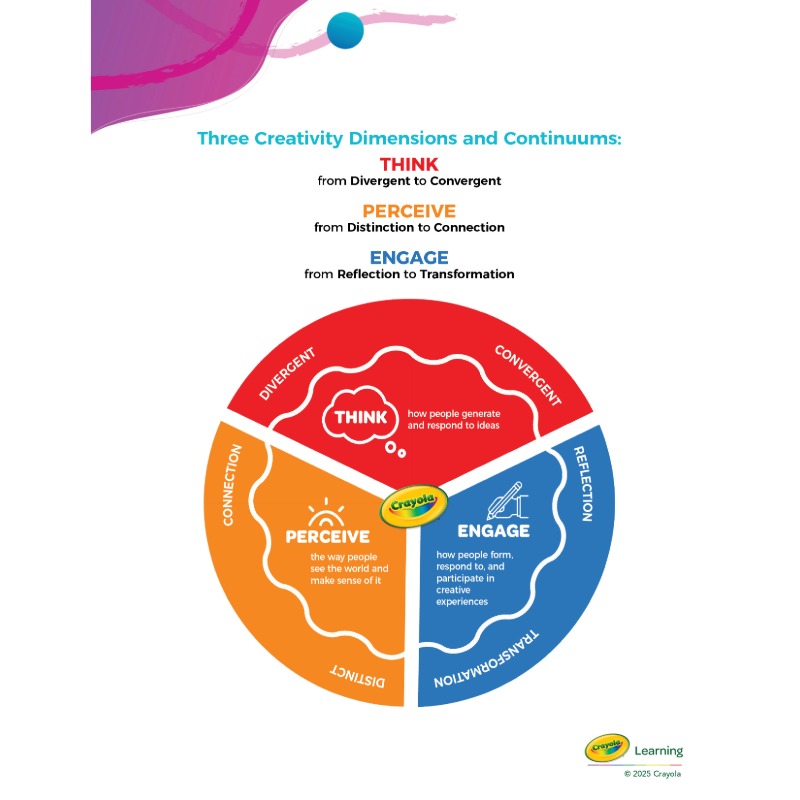
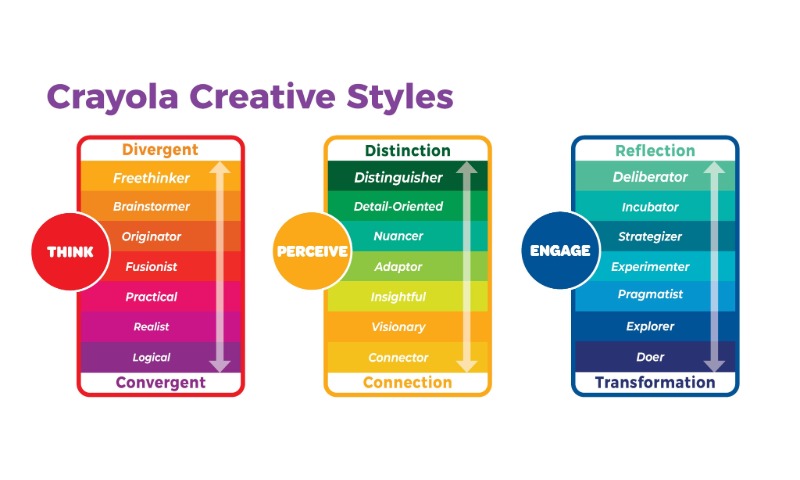
What makes the Crayola Creative Styles model unique is that it does not limit the focus to creative thought. Instead, it leverages decades of research that shows creativity operates across three connected dimensions. Within each dimension, people’s preferences exist along a seven-style continuum.
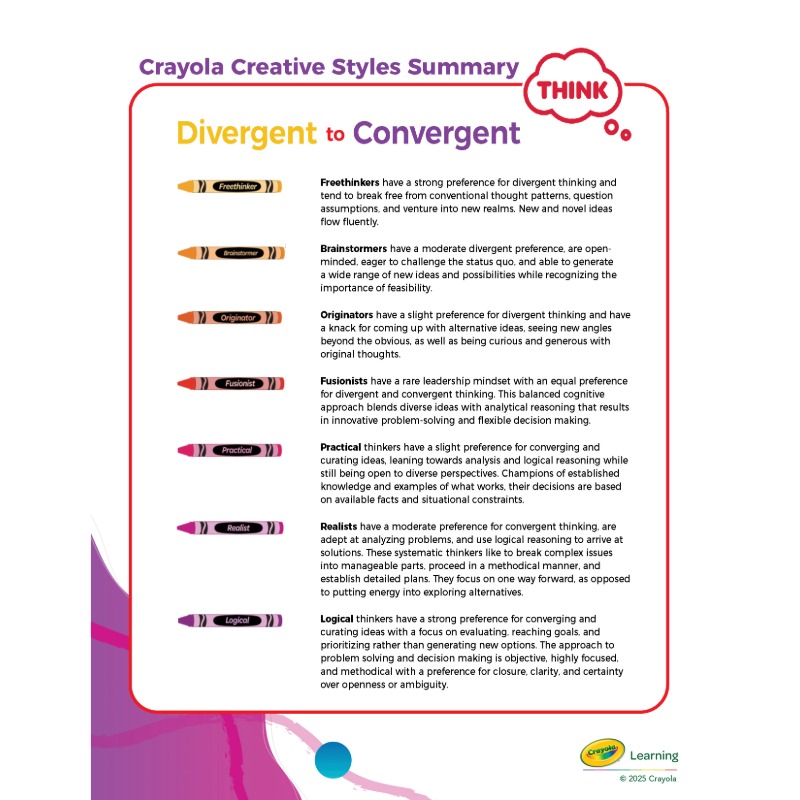
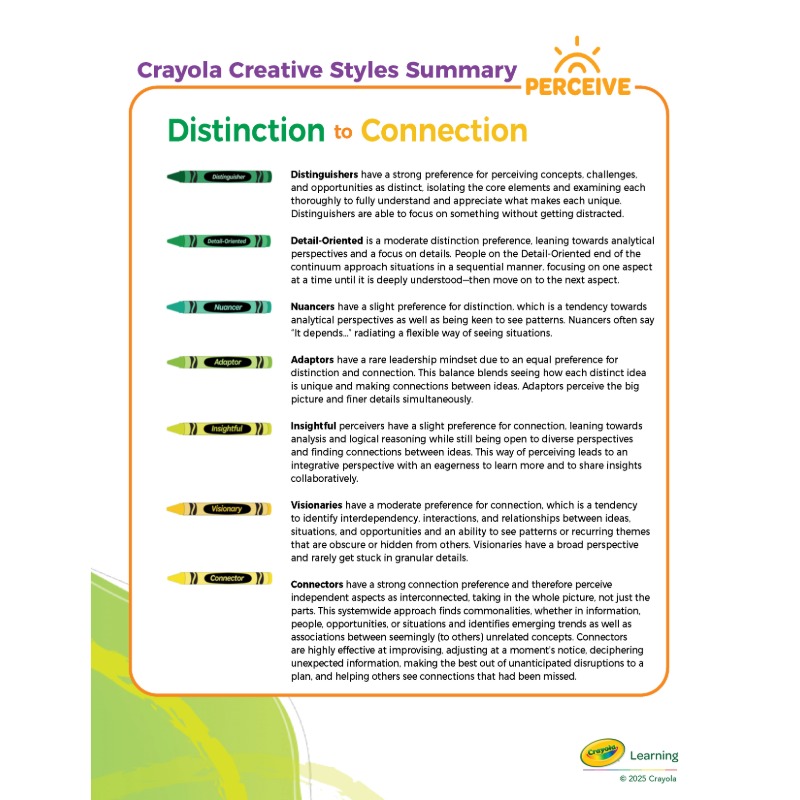
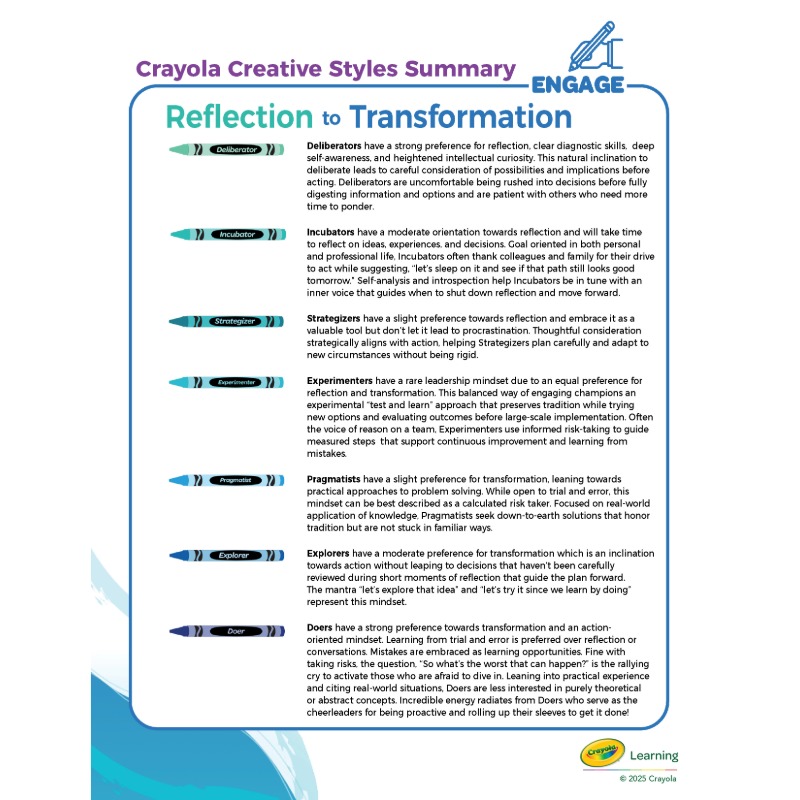
The Think dimension describes how people generate and respond to ideas, ranging from Divergent (expansive, broad) to Convergent (focused, curated). The Perceive dimension reveals how individuals see and make sense of the world, ranging from a preference for Distinction (nuances, stand-alone, differences) to Connection (interwoven, integrated). The Engage dimension interprets how people respond to and participate in experiences, ranging from Reflection (remembering, anticipating) to Transformation (doing, actively experiencing). Every preference on the continuum is as important and creative as the others. Learning communities need diverse styles to help balance decision-making and invite a full range of perspectives and approaches.
7. Using Creative Style Insights to Increase Collaboration with Colleagues
Knowing your work colleagues’ and life partners’ creative styles strengthens collaboration—especially when people use this common language to describe their preferences and understand the different ways they react to new ideas, address problems, and view change. This tool empowers teams to appreciate each other’s unique creative strengths and contributions. Creative Style insights can reduce misunderstandings, calm emotional reactions, and improve communication. Instead of wondering, “Why do they always resist my new ideas?” and “Why do they jump in without a clear plan?,” colleagues will realize their team tensions are not personal affronts. Some people (such as Doers and Explorers) are willing to “fly the airplane while building it” while others (like Deliberators and Incubators) prefer that a plan be finalized before jumping on board. Strong teams need representations across the entire continuum—for example, those who generate many ideas (Freethinkers and Brainstormers), those who curate and focus the strongest ideas (Realists and Logicals), and the styles in between.