



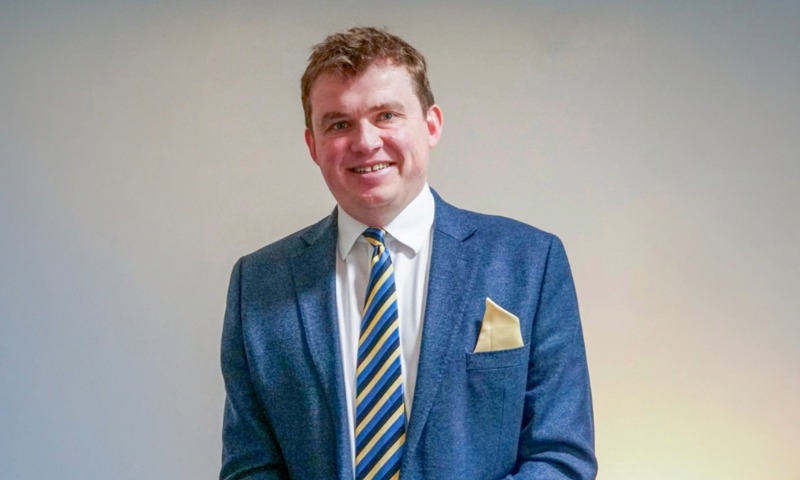
Jonathan Mace is currently Head of Senior School at Strathallan School in Scotland- a leading co-educational day and boarding school. Prior to moving into this promoted role he held the position of Senior Deputy Head and Head of Boarding. Before moving to Scotland in 2022 Jonathan held a number of pastoral and academic management positions in a range of UK independent schools. Jonathan graduated in Economics from the University of Durham before commencing his teaching career at St Edwards’ School Oxford.
In their early teenage years children are asked to make decisions that can play a significant determining role in their future. Parents themselves also feel this pressure intensely- the right nursery, the right school, the right subjects, the right results. Education can begin to resemble a narrowing corridor, each decision closing off another door. In such a climate, breadth is increasingly treated as an indulgence.
This anxiety feels modern but the currents behind it are not.
When Strathallan School was founded in 1912, it was built on a different understanding of education: that young people should first be widened before they are narrowed. Pupils were to be known as individuals, to enjoy their learning, and to discover talents not yet visible to themselves or others. More than a century later, those founding principles feel not old-fashioned, but quietly radical.
Modern schooling systems, shaped heavily by measurable outcomes, often reward early specialisation. Examination pressure, league tables and economic uncertainty encourage schools and parents alike to prioritise efficiency: focus early, choose quickly, optimise where possible. Breadth can appear expensive, risky, distracting or, indeed, not possible.
Increasingly, however, the evidence suggests the opposite.
Analysis by scientists at RPTU Kaiserslautern in Germany, examining the development of elite performers across multiple disciplines, found that early prodigies are rarely the individuals who ultimately achieve the greatest long-term success. Those who excel later in life more commonly follow broader developmental paths. David Epstein, in Range, describes these individuals as “T-shaped”: people who explore widely before eventually developing depth. Their advantage lies not simply in accumulated knowledge, but in adaptability, judgement and the ability to connect ideas across disciplines.
This matters profoundly in schools.
Children do not develop evenly. Curiosity appears unpredictably and sometimes unexpectedly. Confidence arrives at different times. One pupil discovers intellectual independence through debating; another through the economics society; drama production; coding club; or music recital. Potential often remains dormant until the right opportunity, teacher or experience reveals it. Schools that genuinely know their pupils understand this instinctively. They recognise that education is not merely the transmission of information, but the gradual uncovering of identity, the formation of character and the awakening of a love of learning.
Reading sits at the heart of this process.
A reading culture within a school is not simply about literacy outcomes or examination performance, important though those are. Reading widens the inner life. It allows pupils to inhabit different perspectives, wrestle with uncertainty, encounter complexity and develop empathy. In an age increasingly dominated by immediacy and certainty, reading teaches reflection, questioning and intellectual humility.
Critically, reading also resists the narrowing tendencies of modern education. A pupil may study physics and discover philosophy through science writing; another may begin with sports biographies and develop an interest in history, psychology or politics. Books create intellectual cross-pollination and intellectual adventures. In the National Year of Reading in the UK, and one that we are actively celebrating at Strathallan, the words of Dr Rudine Sims Bishop strike a chord “Books are sometimes windows, offering views of worlds that may be real or imagined… They are also doors.” They encourage the very breadth of thought that modern education systems often unintentionally suppress. This is why school culture matters so deeply.
Culture is not built primarily through slogans or strategic plans. It emerges from what a school consistently signals to children about what matters. A culture of breadth says: your value is larger than simply your next grade. It says that music, art, sport, service, outdoor education and reading are not decorative extras, but central components of human development. It says that enjoyment in learning is not evidence of insufficient rigour, but often a precondition for sustained excellence.
Many teachers recognise this intuitively. Pupils who feel known as individuals are more willing to take risks. Those encouraged to explore broadly often become more resilient when difficulty arrives. Enjoyment, contrary to caricature, is not the enemy of achievement. Motivation is not simply the reward for success; it is one of its causes.
School leadership therefore carries a particular responsibility.
Leadership in education is often discussed in operational and financial terms, increasingly so in the UK independent sector: outcomes, targets, KPIs, inspection frameworks and performance indicators. These matter. Schools must be academically ambitious. But leadership also involves protecting a philosophy of education against pressures that constantly threaten to narrow it.
That requires confidence. It is easier, particularly under external pressure, to reduce education to what can be most easily measured. Breadth can appear vulnerable when budgets tighten or accountability intensifies. Yet the schools that leave the deepest mark on young people are rarely those that treated childhood as a production line towards predetermined outcomes. They are the schools that created the conditions in which young people could discover themselves gradually, widely and well.
This is not a soft vision of education. It is a demanding one.
A holistic education requires faith in long-term development rather than short-term optimisation. It requires leaders willing to defend space for reading, creativity, conversation, cross subject pollination, exploration and reflection- even when such things cannot always be immediately quantified. Above all, it requires belief in young people themselves: belief that flourishing cannot be rushed.
The responsibility of schools is not to rush children towards certainty, but to create the conditions where they can flourish.
Parents: take heart. A holistic education is not a soft option. It’s a confident one. It reflects belief in young people and faith in the long game.
The strongest futures are rarely built by racing towards the goal. They are built by young people who were allowed to grow wide before they grew deep.