



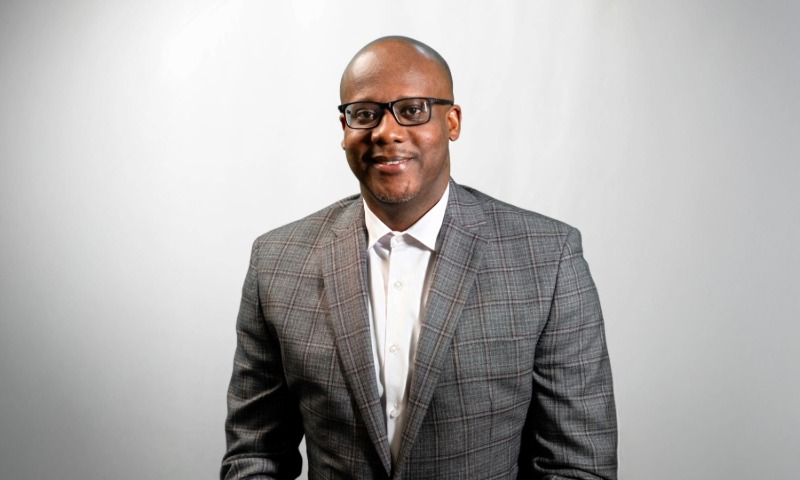
Claubentz Dieujuste is a school leader, consultant, and forthcoming author with over fifteen years of leadership experience in urban public and charter education. He currently serves as Principal of a New York City high school focused on STEAM, where he has built academies, established college and career pathways, and led the integration of AI tools into instructional practice, preparing students for the future. He is the Founder of Meaningful Work Consulting, a leadership development practice focused on helping leaders build systems that multiply their impact. His forthcoming book, “Unscripted Leadership: Stories of Adaptability, Courage, and Impact”, has been released and is now available.
Recently, in an exclusive interview with K12 Digest, Claubentz shared insights into how his leadership calling emerged not in the classroom but in shaping adult practice and school culture, when he discovered his gift for multiplying impact through systems and people. Looking ahead five years, he predicted the fading obsession with standardized testing and a fundamental shift in the teacher’s role — not replaced by AI, but amplified by it, with human care, targeted support, and high-level student dialogue becoming more essential than ever. For new school heads entering the AI era, he named adaptive thinking and continuous, active learning as the single most important leadership muscle — urging leaders to know AI well enough to be credible partners while evolving alongside their students and schools. The following excerpts are taken from the interview.
Hi Claubentz. You started as a classroom teacher in NYC in 1999 and now lead a high-performing charter school while consulting across the country and co-founding a leadership academy in Ghana. When you think back to your first classroom, what was the moment you realized leadership — not just teaching — was your calling?
Early in my teaching career, I moved into a role focused on school culture. That’s when I discovered I had a genuine gift for working with adults and shaping their thinking about their practice. I was trusted with real responsibility: holding the building when leadership was out, managing operations, setting the tone for culture. It wasn’t abstract. It was tangible. That’s when I understood that my impact multiplies when I lead systems and people, not just teach students. Being trusted with those stakes showed me that leadership was where I belonged.
What do you love the most about your current role?
I came into my current position at a pivotal moment when the school needed reimagining. I’ve had the privilege of building something special from that pivot point, starting with shaping the mission and vision statements that guide our work. I’ve created academies, built coherence across departments, established college and career pathways, and I see systems coming together. We will watch students graduate with the credentials we designed for them, whether that’s college credits, industry certifications, or other measurable outcomes. That full arc from conception to student success is irreplaceable.
Urban public and charter schools are navigating enrollment shifts, AI, and new accountability models. Five years from now, what part of the traditional high school experience will be unrecognizable?
The obsession with standardized testing will fade. That’s coming. But more fundamentally, the role of the teacher will shift dramatically. There’s real fear that AI will replace teachers, but once we understand AI as a tool for amplifying impact, the teacher’s role becomes something different entirely. Assessment will move from measuring recall to measuring what students create and imagine. And here’s what becomes even more critical: the conversations teachers have with students will operate at a higher level. The care, the targeted support, the knowing of each student, those things only a human can provide. That relationship becomes more essential, not less.
Student discourse is a cornerstone of your schoolwide expectations. What guardrails do K-12 leaders need to set so AI enhances rather than replaces authentic academic conversation?
I resist the word “guardrails” because it implies restrictions. AI is a thought partner, not just a magic box with all the answers. The student has to own the thinking. At my school, we’ve made a deliberate choice about device use. Laptops are available when they solve a real problem in the task at hand, but we’ve suspended daily classroom use. There is time for devices and time for the human dialogue that happens organically, our meaning is made together. When we walk into classrooms, we want to see and hear students engaged in conversation, not distracted by screens. Families supported this because they were struggling with the device use at home, too. Most teachers embraced it because it minimizes the distractions and strengthens their ability to amplify discourse in their classrooms.
Teacher workload and burnout are real. How can K-12 leaders use AI to reclaim principal and teacher time for coaching, relationships, and culture — not just efficiency?
We adopted an AI-driven platform that teachers can use to plan and use their data faster, saving hours every week. Teachers upload what they want to teach, the standards they’re targeting, and the platform generates engaging options for instruction and assessment. Instead of building lessons from scratch, they review and tweak. It can also automate grading by uploading rubrics, so teachers spend time reviewing rather than manually scoring. When you give teachers those hours back, you have to be intentional about how they’re spent. The culture you build determines whether that time becomes meaningful. And you trust your coaching conversations to reveal whether it’s working.
Every educator has a “north star” thinker. Which historical figure in education, policy, or social justice do you consider a personal mentor from afar?
I am a fan of John Maxwell’s work. His emphasis on humanity and people first aligns with my core belief: my students come first. I value the people who care for them, encourage them, and show genuine appreciation for the work they do each day in service to our children, while holding them accountable. Their work directly shapes how young people navigate their futures. I’ve returned to his book, LeaderShift, repeatedly over the past few years, especially during periods of significant change. Good to Great has also been essential for understanding how systems and disciplines compound impact over time. Both texts ground me when change is happening faster than I can process.
Leaders carry ideas with them for years. Is there a book — education or otherwise — that you reread before every major school year?
LeaderShift by John Maxwell has been in my rotation for the last five years. I don’t reread it cover to cover, but I always have it readily available. I browse back through it for inspiration and recalibration. Other texts shift seasonally, depending on what I’m wrestling with, but LeaderShift is the anchor. It reminds me of the essential changes every leader must embrace, and that’s a message I need to hear before every new year.
Where do you see yourself in the next 5 years?
I see myself working with multiple leaders, helping develop their capacity and increase their impact. I’m not chasing roles or visibility. I want to do meaningful work with leaders building systems that better serve students. A book may travel ahead of me, but I’m not interested in becoming a constant voice or public figure. I believe in staying quiet until I have something meaningful to say. The message gets diluted if you’re talking all the time. My focus is on the work itself: partnering with leaders to build systems that multiply their impact on the young people they serve.
If you were mentoring a new school head today, what would you tell them is the single most important leadership muscle to develop for the AI era?
Adaptive thinking. Continuous learning. Not lifelong learning as something you write on a resume and then ignore, but actual, active evolution alongside a world that won’t stop changing. New leaders need to know AI well enough to speak credibly about it. They should try things themselves, so their teams see them as partners in the work. But underneath that is something deeper: the ability to learn constantly, to stay uncomfortable, to shift when the landscape shifts. Everything is evolving. Your schools are evolving. Your students are evolving. You have to evolve as well.