


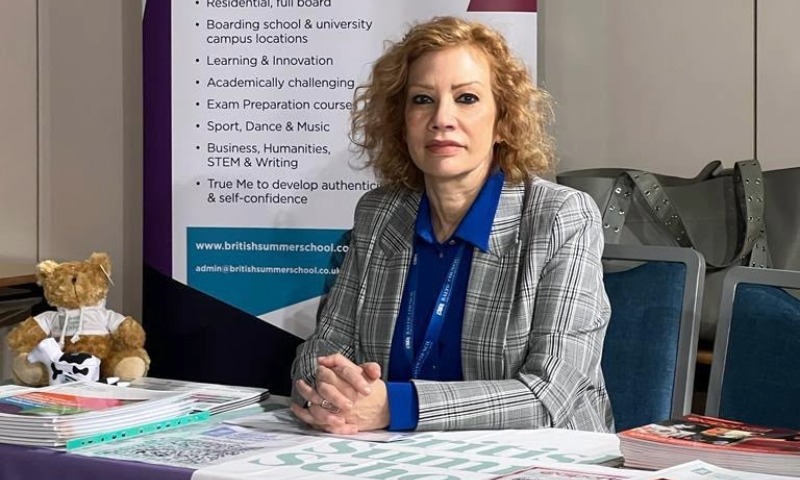
Yolanda Chimeno Beneitez is an education leader with over 30 years of experience across Spain and the UK. She has served as Founding Principal of British Summer School since December 2020, overseeing three operating centres and approximately 100 seasonal staff. Her responsibilities include academic provision, course design, admissions, student welfare, safeguarding, and quality assurance.
Previously, she spent 15 years at Bede’s Summer School, progressing from Welfare Manager to Assistant Principal, a position she held for 12 years across seven centres and 220 seasonal staff. Earlier, she spent 13 years at Lacunza Escuela Internacional / International House in San Sebastián as Director of Studies and teacher trainer, leading syllabus development, academic teams, and teacher training programmes accredited by the University of Barcelona.
She holds a B.A. in Sciences of Education, specialising in Psychology, from the Universidad de Salamanca, an M.A. in Clinical Psychology, Qualified Teacher Status, and accreditation in English teaching management. Her early career included teaching psychology, pedagogy, and special educational needs to trainee teachers, alongside voluntary work as a psychologist.
In an exclusive conversation with K12 Digest, Yolanda talks about the changing role of schools in preparing students for the future, the importance of independence, critical thinking, and creativity, and the responsible use of AI in education. She also shares her leadership philosophy, approach to student wellbeing, and thoughts on building inclusive learning environments. Drawing on her extensive experience, she offers valuable advice to students and aspiring education professionals on resilience, authenticity, and lifelong learning.
Looking back at your career, which experiences have had the greatest influence on your professional journey, and how have they shaped your approach to teaching and leadership?
I came into education leadership through psychology rather than the usual route. My first degree specialised in Psychology; I hold a master’s in Clinical Psychology, and before I held any senior post, I taught psychology, pedagogy and special educational needs to educators preparing for Spain’s public examinations. That training shaped everything afterwards, because it taught me to read behaviour as information — to look past what someone is doing in order to understand why.
I spent thirteen years at Lacunza International House in San Sebastián as Director of studies and teacher trainer, leading syllabus design, assessment, academic staff management and teacher training accredited by the University of Barcelona. That is where the first thing I most want to highlight became concrete: a team is only as strong as the range of people in it, and that range has three dimensions, not one. The first is capacity — what people can actually do — and you build a strong department by reading people accurately and putting them where their strength lies, not by recruiting people who resemble you. The second is personality: the colleague who is quiet may be the one who notices the student everyone else has missed, and the one who challenges you in front of others is uncomfortable to lead and often right. My job has never been to make a team uniform. It has been useful to make a difference. The third is culture, which works differently again: a colleague educated to defer to hierarchy is not disengaged; they are behaving correctly by the standards they grew up with.
But difference is only useful if it is developed, and that brings me to equity in staff training. Training is not neutral. Left to itself, it flows towards the confident and the already strong — the staff who ask for it, the ones who present well, and the ones the leader happens to remember. The people who most need development are exactly the ones who ask least, so equity has to be built into the structure: development genuinely open to everyone, part-time and seasonal colleagues given the same footing as full-time ones, and differentiated offers rather than one undifferentiated group.
The second conviction I formed over fifteen years at Bede’s, where I moved from Welfare Manager, responsible for the wellbeing of international students aged seven to sixteen, through teaching and commercial management of admissions, into twelve years as Assistant Principal across seven centres and 220 seasonal staff. It taught me that genuine leadership is not a technique. In a summer school, staff arrive days before the students do, and the programme is over in weeks; there is no term of meetings in which to build a culture. Staff and students detect performance instantly, so what earns trust is consistency between what you say and how you behave — admitting when you do not know, acknowledging when a decision was wrong, and being the same person in the staffroom as in the parents’ meeting.
So my approach sits on three levels. A transactional floor of clear expectations, sound systems and no ambiguity about welfare. Instructional leadership above that — teaching and learning as the core business, the inheritance of my years as Director of Studies. And above both, leading through people’s professional judgement rather than over it. When something goes wrong, my first question is not who is responsible. It is whether everyone had what they needed to do it well.
What do you consider the biggest challenges facing school education today, and how can educators prepare students to navigate an increasingly complex and interconnected world?
The biggest challenge is not a shortage of information or even of attention. It is that schools are still largely organised around the assumption that knowledge is scarce and that the teacher’s job is to supply it. That assumption has collapsed, and most of our structures have not caught up.
The first consequence is a widening gap between home and school. I want to be careful how I say this, because it is not a complaint about parents. Parents are not adversaries; they are the first educators, and most of them are doing something difficult with very little guidance. But I regularly meet families who love their children deeply and who are, without meaning to, working against the school. A young person is overprotected from consequences — the discomfort of a poor mark, of not being chosen, of a teacher’s fair criticism, of being told no — and their happiness becomes the primary criterion by which the family judges what the school is doing, measured in the short term rather than in what the child is becoming.
Underneath that lies something harder to name. Children have acquired a degree of authority over their own lives that does not correspond to their age, their capacity or their knowledge. Their opinion is treated as decisive on matters they cannot yet weigh, and their feelings as the final verdict on any decision an adult makes. I am not arguing that children should be unheard — the old model of silent authority did real damage, and I have spent my career working with young people whose difficulties were made worse by adults who would not listen. But we have overcorrected. A child’s feelings matter enormously and are always information worth taking seriously. They are not the same thing as a child’s judgement, and putting that opinion back in proportion to their development, without dismissing it, is one of the hardest tasks facing every adult who works with young people now.
The practical cost is what worries me most. Where an adult overrides a teacher’s decision so that a child stays content, the lesson the child learns is not that they are loved. It is that limits are negotiable, that effort is optional, and that someone else will absorb the consequences of their choices. The result is a student who is bright, kind and articulate but who cannot cope with the first serious obstacle they meet.
So what does an educator do? Not blame families, and not accommodate them into educational incoherence, but educate the parents as well as the student. In international summer schools, that is the daily work. I have built communication with families as a structured part of the programme — clear expectations before arrival, honest updates during the course, and someone available to them — and when a parent asks me to soften a consequence I treat the conversation as part of the education rather than an obstacle to it. Schools spend a great deal of energy on parent engagement and not enough on parent education. Engagement is sharing information and inviting people in; education is helping families understand what their child is developmentally facing and where a child’s opinion should and should not be decisive.
The second challenge is that the ground beneath teachers keeps moving, and schools are slow to move with it. Every year brings new frameworks, curricula, inspection expectations and now questions about what artificial intelligence means for assessment and honesty, and teachers are asked to absorb all of it while doing the work that cannot be automated: knowing a child well enough to notice when something has changed. When change arrives faster than the capacity to absorb it, the temptation is to comply on paper and carry on as before — a school that can produce the documentation of improvement without its substance.
The third is that the world our students inhabit is more connected and less coherent than the one we were trained for. A fifteen-year-old may be in a class with people from a dozen countries, following an algorithm that has already decided what she should believe and negotiating a sense of self in public. The information environment is not merely fast; it is curated by systems designed to keep her engaged rather than accurate. And under all of it sits the hardest tension: equity pulls against complexity. Complex challenges are best met with rich resources, small classes and experienced staff — precisely what the most disadvantaged schools have least of.
How then do we prepare students? By making them independent and accepting the cost, because independence means the learner does the thinking, which is slower and less tidy than being told. By teaching critical thinking as a habit rather than a topic so that asking for evidence is routine rather than a module. By protecting creativity, which means tolerating failure visibly, because confidence to make something that did not exist does not survive a classroom where the only acceptable answer is the expected one. And by teaching collaboration as a discipline with real interdependence and adults who model it. Underneath all four is what I have believed since my years as Director of Studies: you cannot force understanding into anyone, and you cannot give someone resilience by removing every difficulty. You can only build the conditions in which a person chooses to think and learns to endure.
How can schools create learning environments that encourage students to develop independence, confidence, critical thinking, and a genuine enthusiasm for learning?
Every school says it wants these four things. What separates the ones that produce them is not ambition but architecture — whether independence and critical thinking are things a school wishes for or things it has deliberately built into the design of its courses, the shape of its lessons, the materials it chooses and the philosophy its teachers are trained in. These qualities do not get added to a curriculum. They are either in it or they are not.
In our case, they live in four places. The first is course design and curriculum. Our syllabuses are written around what students will be able to do by the end of a course, not around content to be covered. The clearest evidence is the shape of the programme itself: we run distinct tracks rather than a single course with students placed by level alone, so the design of the course and the profile of the learner are matched from the outset. Explorers, Artists and Citizens each carry a named emphasis on creativity or communication. Academics add science, maths and engineering. Professionals combine Learning & Innovation with academic English, leadership, life skills and employability. Two things are worth noticing. Learning & Innovation appears in every track, because the capabilities it develops are not the property of one subject. And the variations are real rather than cosmetic, because at sixteen the question is not only what a student knows but also who they are going to be in a workplace.
The second is the types of lessons we provide. A lesson in which the teacher holds the floor for forty minutes cannot produce independent learners, however good the teacher is. Our lessons are built around tasks, projects and problem-solving that students work through without a running commentary, and Learning & Innovation is the lesson type at the centre of all of it, developing critical thinking, collaboration, communication and creativity at once. What matters is how it is structured. The task is open enough that the route is not obvious — if a student can see the answer from the instructions, it is an exercise dressed as a project — so the group must decide how to tackle it, and that decision is where the independence lives. Collaboration is engineered rather than hoped for, with each member carrying a defined responsibility and the process reviewed as well as the product. Communication is built into the outcome, because the task ends with something presented and defended, which is where confidence is forged. Creativity is the output rather than the decoration. And reflection closes the loop: afterwards students ask how they approached it, what they would change, and what they relied on others for. That reflection turns a good activity into a transferable capability, and it is the step most likely to be dropped when time is short.
The third is our core books and materials. If a book is a sequence of exercises with one correct answer at the back, the message reaching the student is that knowledge is settled and the answer lives somewhere else. That is why our core course is Oxford Discover Futures, published by Oxford University Press — a six-level secondary course, CEFR A2 to C1, built explicitly on inquiry-based learning, in which each unit opens with a broad, open-ended question followed by five lesson questions. The questioning drives the learning rather than illustrating it, and the course is written to develop exactly the competencies we are asking about. It is the natural companion to the Learning & Innovation lesson, built on the same premise: that the question does the teaching.
The fourth is our internal philosophy, and it has a name: True Me. It is not a slogan we invented for marketing but the principle our whole approach rests on, and our staff are trained in it. The idea is that a young person who is going to think for themselves, take intellectual risks and keep learning has to be secure enough to do it — and that security comes from knowing who you are and being able to work with other people. So True me develops personal and social skills, self-confidence and authenticity together, because they are not separate. Authenticity in a fifteen-year-old is not a personality trait; it is the outcome of having been in situations where they could find out what they actually think and what they are actually good at and being treated by adults as someone whose view is worth hearing. This is why I would put it underneath the other three rather than beside them. The inquiry-based course, the task-based lesson, the materials that refuse to give you the answer — none of them work with a student who is too frightened of being wrong to speak. True me is the condition that makes the other three possible, and it is why the training matters more than the document. In a summer school this is unusually urgent: staff arrives days before students do, and there is no term in which a culture can grow quietly. You cannot ask people to be genuine while performing a version of yourself.
The through-line is that none of this is stated as a value and hoped for. Independence is in the learning outcomes. Critical thinking, collaboration, communication and creativity are in the structure of the lessons and in the design of the tracks themselves. Reflection is written into the assessment. And True Me is trained into the staff rather than laminated into the handbook. That is what I mean by architecture rather than aspiration: the test of any school is not what it says about these qualities, but where in the design you can actually find them.
How do you see artificial intelligence and emerging technologies changing education, and what should educators prioritise when integrating these tools into students’ learning experiences?
My position is simple to state and difficult to hold in practice: technology in education is a tool, never an end in itself. Every institution I have worked in has been offered something that promised to change learning, and the ones that survived scrutiny could answer one question — what is this for, in a classroom, on a Tuesday morning, with these students? A tool that cannot answer that is a purchase, not a pedagogy.
The interesting thing about a tool is always what it is for. A textbook is a tool, not the curriculum, and it becomes a bad instrument the moment it starts dictating what is worth learning. The same is true of the whiteboard, the platform, the virtual learning environment, and now artificial intelligence. Each was at some point treated as the destination rather than the vehicle, and each, in the schools that got it right, ended up quietly in the background doing useful work while the learning stayed the point. That is where I would like AI to end up: unremarkable, useful and subordinate.
I am not a technophobe, and I do not run a programme in which devices are banned. I use these tools, my staff uses them, and a school that refuses them is not protecting its students but preparing them for a world that no longer exists. But using a tool and being led by it are very different things, and the failure I see most often is not hostility to technology. It is institutions adopting it faster than they can think about it and then discovering that their curriculum, their assessment, and their idea of a good teacher have been quietly rewritten by a supplier.
So what does it look like in practice? It means the learning objective comes first and the tool is chosen afterwards — we begin with what we want a student to be able to do and only then ask which instrument helps, which is sometimes digital and sometimes a book, a discussion, or a student explaining something to their peers. Reversing that order and finding a use for the tool you have already bought is how schools end up with technology that is impressive to visitors and irrelevant to learners. It means the tool never replaces the struggle the learning consists of: I teach language, and there is no version of learning a language in which someone else does your thinking. It means we teach students to judge the tool, not just to use it, because these systems are confidently wrong in a register that sounds authoritative — which makes them the best critical-thinking exercise we have been handed in decades. It means technology answers to pedagogy, and pedagogy answers to purpose: buying the instrument is easy, and redesigning the teaching is hard, so schools buy instead of redesigning and then wonder why the outcomes have not moved.
And it means the human relationship stays at the centre. I hold designated safeguarding responsibility, and in a residential summer school much of what matters is not academic at all — a student who has gone quiet, a group dynamic that has turned, a child who is not safe. None of that is visible to a system that reads text. Any institution using technology to reduce the number of adults in contact with young people is making a decision about safety while believing it is making a decision about efficiency. There is an equity dimension too: the students most likely to be educated primarily by a machine are those whose families cannot buy them anything better, which is the same pattern of advantage reappearing in a new place.
If a school asked me tomorrow where to focus, I would say four things. Train the staff, equitably, including part-time and seasonal colleagues, so competence with these tools is a professional expectation rather than an individual enthusiasm. Teach the tools as a subject rather than treating them as a convenience. Change the assessment rather than policing the cheating, because work a machine can produce is no longer evidence of learning. And protect the unassisted spaces deliberately — the first draft, the problem worked out aloud, the student thinking in front of a teacher — because if those are not designed for, they will quietly disappear while the assisted version stays smoother and faster. None of that is really about artificial intelligence. It is the same discipline I have tried to apply to every instrument in education, and it is why our philosophy is called True me rather than named after any technology we use. A young person who is going to think for themselves has to know who they are, and that is not something a tool can supply.
What leadership principles guide your decisions, and how do you evaluate the success of the educational programmes and initiatives you oversee?
I hold to three principles, and they are the same whatever the scale of the decision — whether I am setting a school’s academic policy or deciding whether to change the timetable on a Tuesday.
The first is that people will only bring their best judgement to something they have been part of building. I came into leadership through psychology, which taught me to read behaviour as information rather than as a fault. A colleague who resists a change is usually not being difficult; they are defending something they do well that my proposal would flatten. So my default when I meet resistance is to look at what it is protecting before I decide what to do about it. That is why I lead through distributed leadership — not because it sounds modern, but because a decision made with the people who will implement it is a better decision and one that survives contact with reality. My job is to be clear about the destination and genuinely open about the route.
The second is that difference is an asset and has to be made useful deliberately. Over thirty years I have led teams diverse in capacity, personality and culture, and I have learned to distinguish between them. Capacity is what people can do, and you put people where their strength lies rather than where you need a body. Personality is temperament, and a team of people who all think the same way is comfortable and blind. Culture is different again: someone educated to defer to hierarchy is not disengaged; they are behaving correctly by the standards they grew up with, and a leader who misreads that loses exactly the honesty they need.
The third holds the other two together: you cannot ask people to be genuine while performing a version of yourself. Our philosophy is called True me, and it applies to staff as much as to students. I have never found a substitute for consistency between what I say and how I behave, and it is why training matters more than the document — equity in staff development is not a courtesy; it is the mechanism by which a stated philosophy becomes a real one.
On evaluation, I work from five kinds of evidence and try not to let any one of them stand alone. The first is feedback from the people who delivered and lived through the programme — students, teachers, welfare staff, activity leaders. It is the richest source a school has, because the people closest to delivery know things no report will surface, and also the most flattering, so I read it seriously and sceptically. A programme that everyone enjoyed and that changed nothing has not succeeded.
The second is parent testimonials. Families are the group who see the programme from outside and over time, and their judgement measures something different: a student’s satisfaction in week two is not the same as a parent’s view three months later about what the experience actually did for their child. Parents notice when a sixteen-year-old comes home able to hold a conversation with adults, or more willing to try something difficult, or clearer about what they want — things no test captures. Where families return, and where they send a second child, I treat that as a harder form of approval than any compliment given at the end of a course.
The third is external evaluation. We are inspected and reviewed by Quality English and by the British Council, and I regard that as one of the most useful things that happens to a programme, because an external reviewer asks the questions an insider has stopped asking. I have never understood leaders who treat inspection as an interruption to the real work; the real work is what inspection tests.
The fourth is student assessment, and this is where I have moved furthest over my career. In our programmes, assessment is largely project-based: presentations, demonstrations, work produced and defended in front of others, and the process as much as the product. I have written and run placement, testing and academic monitoring systems for most of my career, so I believe in measurement — but the assessment that tells me most about whether a programme worked is not a score. It is watching a student present something they have built and explain why they made the choices they made.
The fifth is student self-assessment and reflection, the piece I would defend hardest and the one most likely to be dropped when time is short. Asking students to judge their own work gives me evidence from the learner’s side that no test can produce, and it is itself the skill we are trying to build, because a student who can assess their own learning is independent. In a summer school of four weeks, it is also the only honest way to know whether we have changed anything in a student that will outlast the course.
Two things I hold alongside all of that. I look at who succeeded, not only how many did, because an average hides what matters — if a programme raised outcomes for the students who were already strong and left the rest where they were, it has failed the equity test even if the average looks like a success. So results are disaggregated by level, by first language and by how much support a student needed. The question is not only how the programme performed but for whom. And I ask what it displaced, because every initiative is paid for in the hours a teacher does not spend on something else. Evaluation that produces a report is administration. Evaluation that produces a decision is leadership.
How have your personal interests, values, or experiences outside work influenced your perspective on education and your approach to working with young people?
I have never been able to separate the two, and I have not tried. My education work and my psychology training are not a career that happens to involve young people; they are the same interest pursued from two directions. When I studied Educational Sciences and then Clinical Psychology, I was not collecting qualifications. I was trying to understand why some people learn and some people stop and what an adult can do about the difference.
The psychology came before the leadership. I worked as a volunteer psychologist in Spain, advising educators and producing reports, and later volunteered with a drug advice and intervention service in Eastbourne. Those experiences are why I read behaviour as information rather than as a fault. A young person who refuses to write, who goes silent, who cannot cope with a bad mark — in each case something is being protected, and my instinct has always been to find out what. Teaching Spanish to students with ADHD, dyslexia and anxiety early in my career taught me more about learning than any syllabus I have designed since, because each of those students forced me to ask what was actually getting in the way.
And I know what it is to be the one who does not yet have the words. I have learned a language myself as an adult, and I have lived and worked in another country for a long time. I know what it feels like to be intelligent and inarticulate at the same time — to have a thought fully formed and be unable to say it, to hear a room move on without you, to be treated as less capable because of how you speak rather than what you understand. It is why I have no patience with the idea that a student who is quiet or slow to answer or struggling with the language of instruction is less able. I have been that person. And it is why, when I build a course, I care about the conditions a student needs in order to speak at all — the room, the pace, the safety of being imperfect in public — as much as the content. Learning a language is not primarily an intellectual achievement. It is an act of courage, repeated.
Living in another country taught me something no course could have. I have been the foreigner in a staff room many times, and it changed how I work with people permanently: the same intention is expressed differently in different cultures; directness in one register reads as rudeness in another; and someone who does not challenge you in a meeting may be behaving correctly by the standards they grew up with rather than disengaging. That is exactly why I distinguish between diversity of capacity, of personality and of culture. They are three different things requiring three different responses, and a school that treats them as one will misread its staff and its students in the same way.
What draws me to people is not a professional pose but genuine curiosity about individuals — why this student flourishes in a group and that one needs to work alone, why one colleague blossoms with responsibility and another is crushed by it. That interest is not incidental to my leadership; it is the thing I actually do. A leader’s job is to read people accurately and put them where their strength lies, and you cannot do that if you are not interested in people as individuals rather than as roles.
Interculturality is where my personal experience and my professional conviction meet, and I hold a slightly unfashionable view of it. Intercultural education is not a celebration of difference and not a list of customs to be learned. It is the practical skill of working alongside people whose instincts about authority, directness, time, risk and complaint were formed elsewhere, and getting things done with them anyway. I have had to do that as a colleague, and I watch my students do it as fifteen-year-olds in a residential programme, day after day, in a language that is not their own. That is not a soft dimension of a summer school. In my view, it is the most valuable thing we offer.
Three values I would name. Honesty with young people is a form of respect, and they can tell the difference: I do not flatter students, and a sixteen-year-old will forgive an adult who is strict and fair but not one who is inconsistent. Nobody’s capacity is fixed by their circumstances, which is why I hold to equity as a habit of attention rather than a policy preference — the person in the room who is quiet is often the one with the most to say and who has learned not to try. And independence is the gift, while dependency is the temptation: what I want for a student is not that they remember me or my lessons, but that they can do without me. That is a difficult instinct for a teacher to develop, because being needed feels like success.
Underneath it all is a conviction I have held since my early years of teaching: you cannot force understanding into anyone. You can only create the conditions in which a person chooses to think for themselves. Everything else in my approach is a way of building those conditions — and it began, I think, with a young woman studying psychology who wanted to know why some people stop trying.
What advice would you offer to students preparing for their future and to young professionals aspiring to build meaningful careers in education?
I would give them different advice, because they are facing different questions. But both start with the same observation: the useful things in life are rarely the ones measurable at the moment you acquire them.
To students, I would say this. Learn how to learn. Most of you will work in jobs and with technologies that do not exist yet, which is why the content of what you study matters less than the ability to teach yourself something new, without a teacher, when nobody is requiring it of you. If you leave school only able to be accurate, a machine will outdo you; if you leave able to work out which question to ask, it will not. Expect to be bad at things for a while and stay anyway — people rarely stop learning for lack of talent but because they read the discomfort of being a beginner as evidence that this is not for them. I have been inarticulate in a new language, slow at a new skill, the least capable person in the room, and the only thing separating those who came through it was that they tolerated the feeling long enough to improve. Your character is being built now, in small decisions nobody is watching: whether your work is honest, whether you admit when you do not know, and whether you are the same person as those who can help you and those who cannot. The habits you build at seventeen are the ones you will have at forty.
And be genuinely interested in people, especially the ones who are different from you. You will work with people whose instincts about authority, directness, time and disagreement were formed elsewhere, and getting things done with them is the most useful capability you can develop. It starts with actually asking and actually listening. I tell my own students that a room full of people who agree with you is comfortable and useless — whoever tells you that you are wrong is doing you a favour.
To young professionals in education, I would say this. Decide early that you are there for the students, and accept that it will occasionally cost you. Education is full of things easier than teaching — reports, systems, meetings, the appearance of improvement. All legitimate, almost all less important than what happens in a room with thirty young people in it. And do not confuse being needed with doing your job. The best teachers I have known are the ones whose students become able to work without them; dependency feels like success, and applause is addictive, but if your class cannot function when you are absent, you have built a performance rather than a capability.
Take the unglamorous jobs and learn the whole system. I moved from welfare to teaching to admissions and marketing to senior academic leadership, and the commercial roles taught me as much as the academic ones, because a school is also an organisation. If you want to lead one, do not skip the parts that do not sound like leadership. Be interested in how people are put together — you will work with colleagues who are brilliant and disorganised, anxious and meticulous, quiet and indispensable, and the temptation is to want everyone to be like you. Resist it. Your capacity to see what each person brings and put them where it counts is what will make you a leader rather than a senior teacher.
Stay genuine, and it will do more for you than any technique. I have said this throughout, and I say it as advice because I have never seen it fail. Young people and colleagues detect performance immediately; present a polished self that does not match how you behave under pressure, and you will earn compliance, never commitment. The teacher or leader people trust is the one who says “I do not know” when they do not and “I was wrong” when they were. Get comfortable with being evaluated, too, because you will be observed, inspected and measured. Do not resist it; ask to be looked at closely, and learn to tell criticism of your work from criticism of you, since only one of them is worth defending.
Finally, to both of you. There will be endless noise in your careers — new frameworks, new technologies, each presented as the answer. Technology is a tool, never an end. A framework is a map, not the territory. What does not change is that learning happens when a person chooses to think, and that someone genuinely interested in them is what makes that choice possible. That has been true for as long as people have been teaching, and I do not expect it to change while any of us are working.